




Cell phones today are nearly second-nature. You can walk down the street and see almost everyone holding one. And it's almost impossible to imagine how the trucking industry did without them
A Mobile Industry: Cell Phones Useful to Stay Connected With Drivers
Cell phones today are nearly second-nature. You can walk down the street and see almost everyone holding one. And it's almost impossible to imagine how the trucking industry did without the
by Diana Britton, Managing Editor
October 2, 2009
As an alternative to in-cab devices, cell phones can provide a way for fleets to track drivers, especially when they're doing work outside of the truck.
6 min to read
. It's not really that long ago that drivers had to search out pay phones to call their dispatcher, or were limited to short text messages on a satellite communications tool.
There are many different types of hardware you can use to keep tabs on drivers, including in-cab computers, laptops, routing solutions, tracking and monitoring devices, as well as handhelds devices and cell phones.
The in-cab, mounted computer offers a powerful, dynamic device that can support a number of different applications and keep a fleet's operations tied to the truck, the center of its business. This installed solution is often preferred, especially among large carriers, according to research conducted by Clement Driscoll, president of C.J. Driscoll & Associates, which does consulting and market research in GPS fleet management and related areas.
However, 80 percent of fleet operators said their drivers use cell phones to communicate with headquarters, according to Driscoll's research on cell phone use. "It's very common for drivers to have some kind of mobile communication device," he says. Some carriers use cell phones in addition to in-cab devices. Others can't afford to deploy computers or don't need all the capabilities, so rely solely on cell phones to communicate.
We got you covered
The use of cell phones and mobile handheld devices in the industry has evolved as the amount of coverage on the road has changed. In the 1990s, Driscoll says, satellite-based systems were the norm for fleets to communicate.
Over the years, as cellular phone companies such as Sprint and AT&T have become more competitive, the coverage across the country has become more ubiquitous, and a driver is nearly never out of communications range.
According to Harold Allen, senior marketing manager at AT&T Business Solutions, AT&T's network reaches 98 percent of the population. So even if a truck driver loses coverage while traveling, "they know that in a very short time, they'll be back in coverage."
Not only has coverage improved, but also the cell phones themselves have evolved to where they now can send data, not just voice. With today's wide cellular bandwidth, more data can be transferred over the network, as opposed to satellite, Allen notes.
One example of texting functionality being put to use is TMW's D2Link, a mobile data solution that connects the dispatcher to the driver to streamline load assignment and asset management. The application, designed to run on GPS-enabled wireless phones, enables drivers to communicate with dispatchers through a text format. This allows dispatchers to send out load assignments to 40 drivers in the time it used to take to talk to one driver.
Igor Glubochansky, director of marketing management for AT&T Business Solutions, says 3G technology allows for the simultaneous use of voice and data. This third generation of mobile technology was meant to facilitate growth, expand bandwidth and support more diverse applications. Text messaging also provides the extra benefit of leaving behind a documented trail, he adds.
"By turning your employees' phones into remote data collection units, management can view the drivers' activities, view bread crumb trails for stops and routes taken, which provide accountability for the driver and reliable arrival time for customers," says David Ellis, trucking industry solutions manager at Sprint. "The data that's generated can be stored, making management reporting a snap."
These devices have further evolved to the point where they are no longer just sending and receiving data, but also creating it, says Ben Wiesen, vice president of products and support at Carrier Logistics. Through Carrier Logistics' Facts Mobile Path Driver Communication platform, mobile devices can automatically collect data and send it to the dispatcher, eliminating manual data entry by the driver. This type of system can capture data including time stamps, arrival and departure information, and out-of-route alerts.
Tracking the driver
Tracking equipment assets has become commonplace. But now carriers are finding certain advantages in being able to track the driver as well, through handheld devices. Like cell phones, these offer both voice and data, but also other capabilities such as barcode scanning and signature capture.
With a mobile device, a carrier can track the driver and inventory wherever they go, says Jeff Sibio, industry marketing director at Intermec - back of the truck, in a truckstop, in front of a customer. Sibio calls this "taking the technology to the point of work." This gives a fleet manager "visibility and control over the supply chain," he says.
Intermec recently rolled out new versions of its rugged handheld devices, the CN50 and CN4, with 3.75G and 3.5G wireless technology, respectively. Sealed from dust and moisture, these devices are made for the harsh environment of trucking work, with the ability to withstand drops from 5 feet.
One fleet that wanted to integrate handhelds was Northwest Food Products Transportation, which delivers dairy around the country as a subsidiary of Land O' Lakes. NFPT wanted to keep tabs on the deliveries made by the independent contractors it uses to supplement its company fleet. The company worked with Cadec to develop a handheld version of its DeliveryTracker application.
"As our independent operator base expanded, we needed to ensure that those vehicles would be tied in to our overall fleet management system," says Roger Nordtvedt, director and general manager of NFPT. "Cadec's DeliveryTracker DCS enables us to do that easily and relatively inexpensively, without our having to install fixed systems in contract vehicles."
DeliveryTracker DCS, which runs on handhelds from Honeywell, Intermec and Motorola, provides the fleet with real-time information about delivery and pickup. The application includes a barcode scanner and signature capture capability, says Frank Moreno, vice president of marketing and product management at Cadec.
In the past, the owner-operators had to have customers sign paperwork, which had to be sent back to the home office, taking days. DeliveryTracker makes the transaction paperless and gets the data back to the office in real time.
While the Intermec products and the ones Cadec uses are actually more like small handheld computers, there are applications becoming available for regular cell phones as well. AT&T recently expanded its TeleNav Track GPS services to offer TeleNav Track Lite, a tracking service that provides real-time visibility of field employee locations. The service works on the AT&T wireless network running on virtually all AT&T mobile devices, and does not require software or GPS.
A low-cost alternative
If you compare the cost of a cell phone or handheld device to more traditional in-cab computers, the costs of installation and infrastructure are much lower, making the solutions an affordable alternative, especially for smaller fleets.
Ray West, director of product management at TMW, says smaller fleets tend to move faster in trying out their mobile offerings, as they're more agile and like to jump in on the fly. "They carry that device with them all the time anyway," he adds.
Almost everyone in the trucking industry already owns a cell phone, lowering the cost of implementation for fleets. Even if a driver doesn't have a phone, it is relatively inexpensive to purchase one, and some even come free with a data plan.
"Many of our solutions require very little initial capital to get started, allowing our customers to start small and grow the solution as their business grows," says Sprint's Ellis.
For the smallest fleets, the owner-operator, there's even an iPhone ap
Subscribe to Our Newsletter
More Fleet Management

'Beyond Compliance,' Regulations, Driver Coaching on ATRI’s 2026 Research List
The American Transportation Research Institute will examine driver coaching, regulatory impacts — including the "Beyond Compliance" concept —and weather disruptions that shape trucking operations.
Read More →
Fleet Advantage's Brian Antonellis on the Growing Need to Replace Old Trucks
Fleet Advantage's Brian Antonellis says it's time for fleets to get back to the fundamentals of good maintenance practices. And that includes replacing older, inefficient equipment.
Read More →
Truckstop.com Adding to Open Deck, Heavy Haul Offerings
Load matching for flatbed, lowbed, oversize and overweight loads can't be automated like basic van freight, but Truckstop.com is adding more high-tech tools to help.
Read More →
Trucker Path, Truckstop.com Expand Load Access Partnership
An expanded Trucker Path and Truckstop.com integration brings more freight opportunities into the TruckLoads app while emphasizing security and network quality.
Read More →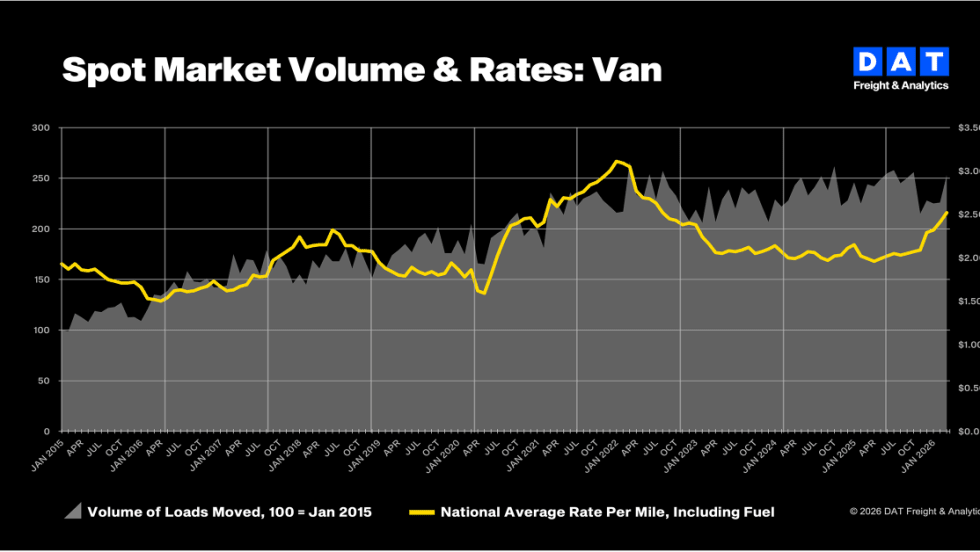
Truckload Rates Hit Two-Year Highs as Diesel Costs Surge, DAT Says
Strong March freight demand combined with a spike in fuel costs pushed both spot and contract truckload rates to their highest levels in more than two years.
Read More →
The AI Conversation You Need to Have with Your TMS Provider
Everyone’s talking about AI — but is your transportation management system actually built for it?
Read More →
Kriska Buys Fellow Canadian Carrier Sharp Transportation Systems
Being part of KTG will allow Sharp to expand and improve its services.
Read More →
Bill in House Would Raise Minimum Insurance for Motor Carriers to $5 Million
The Fair Compensation for Truck Crash Victims Act would increase insurance requirements for interstate motor carriers by nearly seven times.
Read More →
FTR Trucking Conditions Index Hits Four-Year High in February
Strong freight rates push TCI to 10.2, but FTR expects fuel-price volatility to skew March results.
Read More →
C.H. Robinson Offers Carriers Relief as Diesel Prices Surge
C.H. Robinson is waiving fees on fuel cards and cash advances for April and May, aiming to help carriers offset rising diesel costs tied to geopolitical instability.
Read More →