




Since the new hours-of-service rules went into effect July 1, there have been many questions asked of experts both inside and outside of the Federal Motor Carrier Safety Administration related to the new rules. In this article we will look at some of the more frequently asked questions we here at J.J. Keller & Associates have been receiving.
Answers to Your Questions About the New Hours of Service Rules
Since the new hours-of-service rules went into effect July 1, there have been many questions asked of experts both inside and outside of the Federal Motor Carrier Safety Administration related to the new rules. This article looks at some of the more frequently asked questions.
by Tom Bray, J.J. Keller
July 24, 2013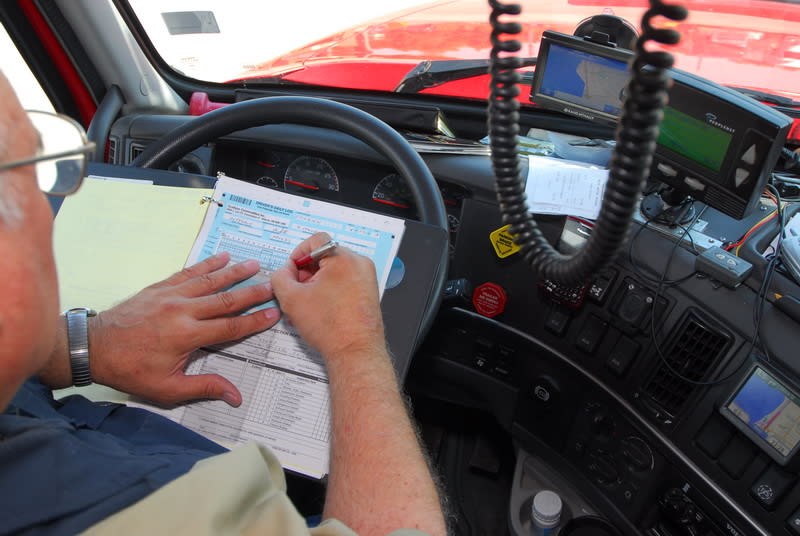
6 min to read

30-minute break
Question: Does the break need to be taken right at 8 hours?
Answer: No. the break can be taken at any time before the end of the 8th hour of duty. The regulation only requires that the driver stop driving and take the 30-minute break if it has been 8 hours since the driver’s last break of 30 minutes or more.
Question: If I am unloading or fueling when I reach the point where it has been 8 hours since my last break of 30 minutes or more, do I have to stop what I’m doing and take the break?
Answer: No. The only thing a driver cannot do once the 8 hours is reached is drive. The driver would be able to finish unloading or fueling, but would then have to take a 30-minute break before driving again.
Question: The company I am leased to does not have an “off-duty policy.” Do I need to log the break as “on-duty” rather than “off duty”?
Answer: Unless you are transporting certain explosives or radioactive materials, you must log the break as off-duty or sleeper-berth time. To be able to log off duty, you must be relieved of all duty and responsibility, and at liberty to pursue activities of your own choosing. Whether your company has a policy allowing this or not is moot, since the regulations require it.
Question: We haul flammable liquids and corrosives. Am I supposed to be logging the break on duty due to the attendance requirements?
Answer: The attendance requirements for hazardous materials other than 1.1, 1.2, and 1.3 explosives only apply if the vehicle is parked on the roadway or the right-of-way. As long as the vehicle is off of the roadway and right-of-way, the driver can log off duty. Therefore, a driver hauling non-explosive hazardous materials must park in a safe and secure location off the roadway, and then take the 30 minutes off duty.
Question: What drivers are allowed to disregard the 30-minute break requirement?
Answer: Presently, there are three exceptions to the 30-minute break requirement, and only one allows the driver to completely disregard the requirement. These are:
Drivers transporting 1.1, 1.2, and 1.3 explosives: When a driver is transporting 1.1, 1.2, or 1.3 explosives, the driver must still stop and take the break, but the break must be logged on duty due to the driver having to stay in attendance of the vehicle.
Drivers transporting route controlled Department of Energy (DOE) highly radioactive materials: When a driver is transporting these highly radioactive materials, the driver must still stop and take the break, but the break must be logged on duty due to the driver having to stay in attendance of the vehicle.
Drivers transporting livestock: When loaded with live animals (including poultry, fish, and even lobsters) a driver does not have to stop and take the 30-minute break. This exception only applies in July, August, and September 2013 due to the predicted heat.
Question: What special note do I need to put on my log to show when the break took place?
Answer: The FMCSA has stated that there are no “special documentation requirements” when it comes to the 30-minute break. This is because there is no special entry required in the hours-of-service regulations at §395.3, which is the regulation that changed. There were also no changes to the regulations stating what must be on the driver’s log (the regulations at §395.8). The 30-minute period on either line 1 (off duty) or line 2 (sleeper berth) of the driver’s grid graph, with city and state shown in the remarks, is all that is required.
34-hour restart
Question: The rule says a driver can only have one restart in every 7-day (168-hour) period. When does the 7-day/168-hour clock “start”?
Answer: The rule requires that a driver not start his/her next restart break until 168 hours have passed since the start of the driver’s last restart break. Therefore, if a driver started his/her last restart at 8:00 p.m. on Friday night, the earliest the driver could start his/her next restart break would be 8:00 p.m. the following Friday.
Question: Does this new rule mean that a driver cannot be given 34 hours or more off more than once per week?
Answer: No. Drivers can have off all the time they and their companies agree to. The only issue is that a driver who gets two (or more) breaks in a 7-day period that qualify as restarts must indicate which one (if any) is to be considered the restart.
Question: Since the restart can only be taken once per week (every 168 hours), what happens if I run out of hours 5 days after my last restart?
Answer: You can start driving again as soon as you have hours available under the 60 or 70 hours limit (based on the your recap) or you get a 34-hour restart that started more than 168 hours after the start of your last restart and includes two 1 a.m. to 5 a.m. periods.
Question: Is a restart still going to be required when I run out of hours?
Answer: While a common practice, a driver taking a restart after running out of hours has never been required. If a driver runs out of hours today, but does his/her recap and determines that he/she will have hours available tomorrow, the driver can go ahead and use the available hours the next day (the driver does not have to wait for a restart).
Question: Is a driver required to stop and take a restart every 168 hours?
Answer: There is no requirement that the driver take a restart at any time. If the driver has hours available under his/her recap, the driver can continue to drive.
Question: Does the restart have to be taken at the driver’s home or home terminal to be considered a valid restart?
Answer: No, it does not. There has been some confusion on this as the rules require that the restart be taken in the driver’s “home terminal time.” What this means is the restart period, including the two 1 a.m. to 5 a.m. periods, must be based on the driver’s “log time,” not the local time. So, if a driver who is based in Philadelphia (Eastern time zone) is in San Francisco (Pacific time zone) doing a restart, the driver’s two 1 a.m. to 5 a.m. periods must be based on Eastern time (the driver’s “log time”).
This is a sampling of common questions we have been receiving. If you have questions, be careful about whom you ask. You want to be sure to get the facts, even if you might not agree with them, not someone’s opinion. In other words, be sure to contact an expert that will give you an accurate answer, even if it is unpopular!
Thomas Bray is an editor in the Transportation Publishing Department of the Editorial Resource Unit at J.J. Keller & Associates, Inc., specializing in motor carrier safety and operations management.
Subscribe to Our Newsletter
More Drivers

FMCSA Extends Paper Medical Card Exemption … Again
Five states still aren't ready to accept commercial driver medical exam information directly from the medical examiner's registry.
Read More →
Mack Launches Digital Driver Guide for Chassis-Specific Truck Info
Mack’s new, virtual owner’s manual delivers VIN-based, on-demand guidance for vehicle systems via web, app, and soon in-cab displays.
Read More →
Western Star Showcases Truckers' Pride and Skill
Western Star is expanding its Star Nation Experience in 2026, adding new competitions and dealer participation to highlight operator skills and promote careers in trucking.
Read More →
Best Fleets to Drive For: Two Carriers Earn Overall Award for First Time
CarriersEdge announced the 2026 Best Fleets to Drive For overall winners, with Crawford Trucking, Fortigo Freight Services, and FTC Transportation receiving top awards.
Read More →
Federal Proposal Would Allow Pell Grants for Shorter-Term Job Training
The Department of Labor plans to expand Pell Grant eligibility to some shorter workforce training programs, a move the American Trucking Associations said will help strengthen commercial driver training schools and diesel technician training programs.
Read More →
Owner-Operator Model Gets Boost as DOL Proposes 2024 Independent Contractor Definition Reversal
For an industry that has watched this issue go back and forth for years, the independent contractor proposal marks the latest swing in the regulatory pendulum.
Read More →
FMCSA Reinstates Field Warrior ELD to Registered Device List
One electronic logging device has been reinstated to the FMCSA's list of registered ELDs.
Read More →
How One Company is Using Smart Suspension Technology to Reduce Driver Injuries and Improve Retention
America’s Service Line adopted Link’s SmartValve and ROI Cabmate systems to address whole-body vibration, repetitive strain, and driver turnover. The trucking fleet is already seeing measurable results.
Read More →
CarriersEdge Announces 2026 Best Fleets to Drive For
The 18th annual contest recognizing the best workplaces for truck drivers sees changes to Top 20, Hall of Fame
Read More →
FMCSA Targets 550+ ‘Sham’ CDL Schools in Nationwide Sting Operation
The Federal Motor Carrier Safety Administration issued more than 550 notices of proposed removal to commercial driver training providers following a five-day nationwide enforcement sweep. Investigators cited unqualified instructors, improper training vehicles, and failure to meet federal and state requirements.
Read More →