





The intermodal container business has allowed many companies to shift longer-haul freight to rails in the face of tight capacity and a driver shortage. But in recent years, Schneider and a handful of other fleets have turned that same concept to the liquid bulk business.
Bulk Intermodal a Hit for Schneider
The intermodal container business has allowed many companies to shift longer-haul freight to rails in the face of tight capacity and a driver shortage. But in recent years, Schneider and a handful of other companies have turned that same concept to the liquid bulk business.
June 15, 2018
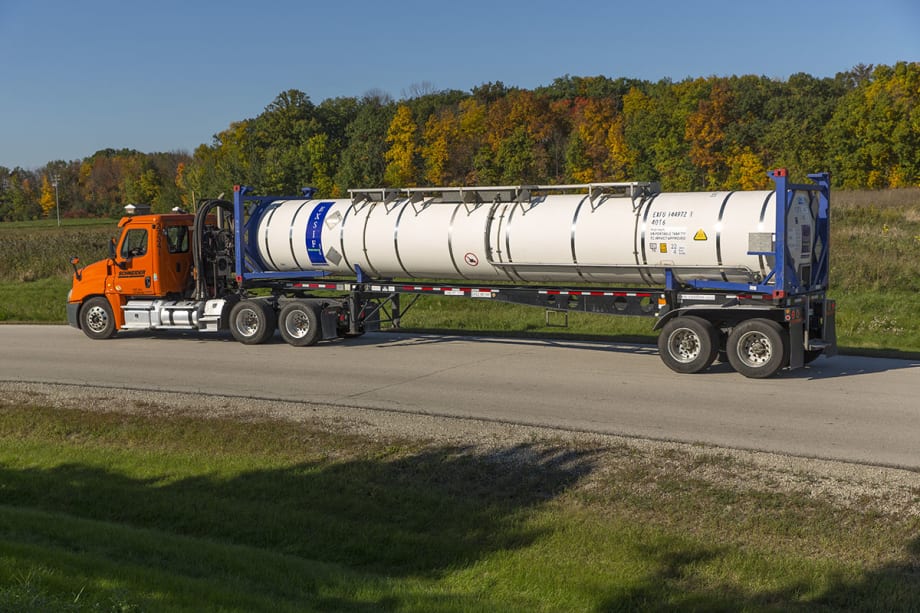
Schneider worked with tank companies and the railroads to develop a way to ship liquid bulk loads intermodally.
Photo courtesy Schneider
4 min to read
Schneider is celebrating the sixth anniversary of its first bulk intermodal container movement, which it says was one of the first in the industry.
It was a fairly lengthy process to study the opportunities, work with the railroads, and develop a special container, explains Jason Howe, who moved from Schneider’s van truckload business several months ago to become senior vice president and general manager of Schneider’s Bulk division.
“It operates very similar to our dry intermodal business,” he explained in an interview. “You think of this tank on a frame, a bit of a capsule-looking tank surrounded by a square frame. That square frame is really the box and it sits on the chassis. The crane comes just like an intermodal dry container, picks up that frame, and sets it in the well car on the train.”
Schneider is currently operating about 400 of these containers, up from the 100 it started with back in 2012. The company started offering this service in 2012 with two customers, and by late 2017 it had grown to 68 customers.
Fast-growing business
During the initial years of operating Bulk Intermodal containers, Schneider focused on building out its service and growing relationships with the rails. Then, in the first six months of 2014, capacity-crunched chemical shippers latched onto Schneider’s Bulk Intermodal offering, increasing the company’s volume by 75%. First-quarter 2018 results show that Bulk Intermodal volume continues to grow, increasing 13.5% year-over-year.
“The chemical and liquid bulk shipping industry has not been immune to the capacity challenges you read about across transportation in general,” Howe said.
The growth of the chemical industry also contributes to the demand. According to the American Chemistry Council, there are plans for 294 new production units for chemicals in the U.S. – representing $179 billion in new capital investment in the industry. “We would like to say we can apply this to almost all our existing product base across the chemical business,” Howe said, such as polymers, monomers, water treatment chemicals, and lubricants.
“With an improving economy and growing driver shortage, bulk shippers are experiencing extremely tight capacity conditions,” Howe said.
Unique to the 40-foot Schneider Bulk Intermodal containers, according to the company, is the ability to haul up to 45,600 pounds of specialty chemical and liquid payloads. Also, unlike the typical ISO bulk 20-foot containers, Schneider’s Bulk Intermodal containers:
Have standard fittings for easy offloading
Fit standard loading racks for safe service
Give shippers the feel of a regular tank trailer for ease of use and consistency
Opportunity for Drayage Drivers
Schneider is hiring dray drivers dedicated to Bulk Intermodal at major ramps in all major bulk markets.
Bulk intermodal, Howe explained, “frees up drivers to move other product while these containers are moving on the train, so the train runs the long miles and allows our trucks and drivers to move other freight.”
The increased need for drayage drivers to handle the move at both ends “is a really positive thing in this environment, where we have driver associates and candidates looking for more time at home. The intermodal business in general is more suited to that. It allows us to hire drivers who are interested in only that and also drivers in our existing business who may want to come off the road and drive local for a while.”
Unlike intermodal containers, which are onloaded and offloaded by cranes at both ends of such a move, bulk intermodal containers require more interaction from drivers.
“There’s some specialized training that’s required for the bulk drayage drivers,” Howe said. “Loading and offloading is still fairly unique and specialized.” There are different training and hazardous materials requirements, knowing how to operate the pumps and compressors and hoses for loading and unloading, etc.
“It’s all about finding the right candidate, the right driver who’s interested in doing the right kind of work,” Howe said. “What I’ve learned in my time in the liquid bulk space is it’s a different kind of driver, who wants to interface with customers more directly and be part of that customer’s supply chain – and that can be very different from some of our dry business, where it may be drop and hook and very little interface. We try to match the driver candidate in the best place they are going to be comfortable and able to succeed.”
Related: Schneider Completes Shift to Company-Owned Intermodal Chassis Network
Subscribe to Our Newsletter
More Fleet Management

'Beyond Compliance,' Regulations, Driver Coaching on ATRI’s 2026 Research List
The American Transportation Research Institute will examine driver coaching, regulatory impacts — including the "Beyond Compliance" concept —and weather disruptions that shape trucking operations.
Read More →
Fleet Advantage's Brian Antonellis on the Growing Need to Replace Old Trucks
Fleet Advantage's Brian Antonellis says it's time for fleets to get back to the fundamentals of good maintenance practices. And that includes replacing older, inefficient equipment.
Read More →
Truckstop.com Adding to Open Deck, Heavy Haul Offerings
Load matching for flatbed, lowbed, oversize and overweight loads can't be automated like basic van freight, but Truckstop.com is adding more high-tech tools to help.
Read More →
Trucker Path, Truckstop.com Expand Load Access Partnership
An expanded Trucker Path and Truckstop.com integration brings more freight opportunities into the TruckLoads app while emphasizing security and network quality.
Read More →
Truckload Rates Hit Two-Year Highs as Diesel Costs Surge, DAT Says
Strong March freight demand combined with a spike in fuel costs pushed both spot and contract truckload rates to their highest levels in more than two years.
Read More →
The AI Conversation You Need to Have with Your TMS Provider
Everyone’s talking about AI — but is your transportation management system actually built for it?
Read More →
Kriska Buys Fellow Canadian Carrier Sharp Transportation Systems
Being part of KTG will allow Sharp to expand and improve its services.
Read More →
Bill in House Would Raise Minimum Insurance for Motor Carriers to $5 Million
The Fair Compensation for Truck Crash Victims Act would increase insurance requirements for interstate motor carriers by nearly seven times.
Read More →
FTR Trucking Conditions Index Hits Four-Year High in February
Strong freight rates push TCI to 10.2, but FTR expects fuel-price volatility to skew March results.
Read More →
C.H. Robinson Offers Carriers Relief as Diesel Prices Surge
C.H. Robinson is waiving fees on fuel cards and cash advances for April and May, aiming to help carriers offset rising diesel costs tied to geopolitical instability.
Read More →