





There's no B-Team in trucking. Nor do parallel roadways exist where inexperienced rookies can safely hone their skills before stepping onto the big road with the pros.
Driver Training: You Get What You Pay For
There's no B-Team in trucking. Nor do parallel roadways exist where inexperienced rookies can safely hone their skills before stepping onto the big road with the pros
September 17, 2012

10 min to read
Trucking isn't like some professional sports where the up-and-comers spend time on farm teams perfecting their craft.
Drivers of all calibers - pros, bumbling four-wheelers and rookie CDL holders alike - have to share the same 36 feet of roadway. There's no room for mistakes.
That has always been the stark reality, but the Federal Motor Carrier Safety Administration's new fleet scorecard, Compliance, Safety, Accountability, ratchets the situation down even tighter. Drivers no longer have the luxury of learning on the job. Every mistake a driver makes, including all the inevitable gaffes any worker new to a field is going to make, now count against his or her employer.
So where will trucking find all the "fully trained" rookie drivers they'll need?
The CSA-driven demand for proficiency raises several questions that are related to driver training:
- Is entry-level driver training adequate in this new operating environment?
- Are drivers' current knowledge and skill levels adequate?
- Can we afford to train drivers to meet the demands imposed by CSA?
- Who provides the training and education needed to raise the bar on driver skills?
- What will it cost to produce and maintain a highly skilled, professional workforce?
In a research paper produced by the Transportation Research Board in 2003, "Effective Commercial Truck and Bus Safety Management Techniques," the authors concluded that "the level of driving proficiency and knowledge required to earn a commercial drivers license is widely regarded in industry as well below the level required to be a safe and reliable driver in a full-time operational setting."
In fact, studies dating back to 1995 suggest commercial drivers generally don't receive adequate entry-level training.
How do you measure training?
The authors of the report say there's no reliable barometer for driver training.
The most often used standard for measuring training effectiveness, the report found, was CDL test pass rate. If significant numbers of students were receiving their CDL (more than 70%), the schools were seen as successful. For schools, another measure of success was the number of graduates hired for driving positions.
"Carriers had some general sense of improved safety performance resulting from training, but firm data were in short supply," it notes.
Todd Spencer, executive vice president of the Owner-Operator Independent Drivers Association - which has called for mandatory requirements for CDL training - notes that even the federal Large Truck Crash Causation study was largely silent on skill and experience levels as factors in truck crashes.
"They didn't ask any questions about age or experience," he says. "They spoke extensively about mechanical factors, but look, a good driver can operate almost any kind of equipment safely. Conversely, there's nothing you can put on a truck that will keep a bad driver from crashing it."
The problem may not be the inadequacy of the training, but the industry's willingness to accept sub-standard training, and/or a reluctance or inability to pay for adequate training.
Many students fund their own initial training. Most are unemployed or under-employed at the time of entry, so they simply cannot afford what might be considered sufficient training to make them competent drivers the day they graduate.
In Canada, The Canadian Trucking Human Resources Council developed an entry-level driver curriculum based on what carriers indicated they wanted in new drivers. The Earning Your Wheels program debuted in 1995 and was revised substantially in 2005 to reflect changes in workplace technology. The course runs 12 weeks and costs the student more than $10,000 - but it's what carriers said they wanted.
In the U.S., the Professional Truck Driver Institute offers afford what might be considered certification to schools using curriculum standards set by PTDI. This is shorter and less expensive than the Canadian EYW program, but PTDI notes that this is "the minimum curriculum content necessary for mastering the skills for the entry-level commercial motor vehicle driver."
"PTDI has had a positive effect on a lot of schools, even those that haven't gotten PTDI certification," says Kerry Kearl, vice president of company fleets for Nebraska-based Crete Carrier on the group's website. "I think companies have seen the value of these standards. PTDI's most significant contribution was to establish the amount of hours required and topics covered for entry-level driver training and to make the schools accountable."
While PTDI and EYW offer a structured and in some cases certified training curricula, many more schools offer in-house courses. Course costs and duration vary widely, from less than three weeks to as long as six weeks, on average. Some include home study and classroom study. Some are full time, some part time, depending on the needs of the student. Costs seem to vary from lows of $1,500 to highs of $4,000.
Taking the median, can a school create a road-ready driver in four weeks for about $2,500? If pass rates are an indicator, they may emerge with a CDL, but most would agree they certainly aren't ready for the real world.
"Look at the big picture," says Spencer. "An entry-level driver has been trained on nothing, but under CSA he or she is responsible for everything."
In its curriculum guidelines, PTDI agrees, emphasizing that this curriculum is designed to create an "entry-level" driver - someone who has the knowledge and skill to operate a commercial vehicle safely, but lacks the experience to perform as a solo driver. It says longer programs that include additional instruction and an "externship" can prepare students to be solo drivers.
The externship option allows a training program to defer about a third of the behind-the-wheel training hours of a driver to a trucking firm, where that time would actually be completed under the close supervision of a driver-trainer attached to the firm.
Obviously, the motor carrier employer has some obligation to refine or finish the training the student received in school - or accept the drivers' skill level for what it is. CSA, however, will likely put a stop to the latter.
The finishing touch
An old joke comes to mind. A rookie driver, having made it through orientation and a few weeks on the road in a team finishing program, is interviewed by the safety director.
"Here's a scenario," the director says. "You're driving down a steep hill with a train crossing the highway at the bottom. You notice the first signs of brake fade, and the truck is getting difficult to hold back. Tell me what you'd do."
Says the rookie: "I'd wake up my trainer. He told me he's never seen a really big wreck."
That approach would never fly at Motor Carrier Service of Northwood, Ohio. President Keith Tuttle has implemented a disciplined and very regimented driver finishing school to bring entry-level drivers into the company.
"We've had to completely change our thinking on bringing inexperienced drivers into the fleet thanks to the ramifications of our aging workforce and CSA," Tuttle says. "We would never have done this three years ago, but today we work with two driving schools in the area, and we offer training positions to drivers that finish in the top 20% of their class, after we have interviewed them to make sure we meet each other's needs."
The finishing program at MCS (a regional carrier) is not a team operation. Tuttle says the students drive the entire time while the trainer sits in the passenger seat evaluating the student. When a driver is handed off to a different trainer, they compare notes on the driver's progress. Even after they are soloed, the trainers stay in contact and mentor the drivers through the transition to solo driver.
They learn the paperwork, manners on the dock, the Qualcomm system and they learn about the customers. Every single day the trainers work through a checklist and report everything the student does.
"It's really not cheap," Tuttle says. "We pay the trainers their regular mileage, which with their experience puts them up into the mid-forties, plus a safety bonus and a few hundred dollars a week for the training.
"As for the students, they are paid at a bit of a discount, but not that much. They still have to be able to make living while they are learning. All in, labor costs are about 75 to 80 cents a mile to run a truck with two people onboard - but it's a fraction of the cost of a lost customer or a wreck, or a series of CSA violations stemming from lack of awareness or poor training. When it comes to risk and reward, it's worth it."
That's refreshing thinking when the standard operating procedure in this industry is to steal a competitor's experienced drivers, observes Bob Rose, a former fleet manager and now a technical training content editor with J.J. Keller & Associates. "That paradigm has to change. In my experience, the companies that have made the investment in their people have little trouble hanging on to those employees and attracting new ones."
As for hiring experienced drivers, Tuttle's all for it, but there's cost there, too.
"We bring on our share of experienced drivers, and let me say, some of them have lots of what I'll call bad habits," he says. "We have to work to change those, and that comes at a cost. With the new drivers, we have them first, so we can train them how we want them to be as drivers for our company. They don't bring a lot of baggage with them."
Driver development
Training shouldn't stop once you feel the rookie driver's qualified to operate on his own.
One of the oft-heard criticisms of trucking as a career is the lack of career development. Once you have a CDL, you're set for life - there's nothing more you need to know or have to learn, no more tests to pass, and no reason to want to get any better than you need to be.
CSA will change that, too. There's more to driving a truck than safely steering it down the road, and some of those softer skills are noticeably lacking in many drivers - largely, Rose says, because fleets don't yet see a return in their training investment.
"Doctors and pilots are the two best examples," Rose says. "Society places a high degree of trust in both professions, and they get the training and skills upgrading they need to stay on top of their game. Well, the public places a very high degree of trust in truck drivers as well. This industry needs to step up to the plate to ensure our drivers are the best they can be. Under CSA, there's no more room for tribal learning and truckstop lawyers. We're talking professionalism."
Show me the money
The next question is, why would a prospective student driver invest any money training for a $38,000 a year job? Rose notes the median starting pay for an entry-level driver works out to about $13 per hour. Drivers would see that climb to about $ 15 per hour within a couple of years. That's not much to get excited about, even if you work the night shift at a 7-11.
Increased professionalism, increased wages and increased training costs all have to be funded. Who should pay?
"Put in 20% compounded for the next three years, and stick with it," say Jim Mickey, co-president of British Columbia-based Coastal Pacific Xpress and a former HDT Truck Fleet Innovator. "Shippers will look at you like you have two heads, but it's the only way we'll be able to afford to hire and train the right people. The shipping community needs to learn that this is the way it has to be or the freight won't move."
Mickey says we need 50% more revenue today to live up to CSA on all fronts.
"We're not sticking 45% in our pockets. Nor is it a ransom; we're just asking shippers to fund the extraordinary cost of the new reality, whether it's on a one-load basis or a gradual trend that ramps up over the next few years to keep us ahead of the curve."
Professional sports teams know the value - and the cost - of operating their farm teams, but how else would they develop new talent? Since trucking doesn't have a proverbial B-Team, it will have to spend its development money in other ways. But it has to be spent.
Subscribe to Our Newsletter
More Fleet Management

'Beyond Compliance,' Regulations, Driver Coaching on ATRI’s 2026 Research List
The American Transportation Research Institute will examine driver coaching, regulatory impacts — including the "Beyond Compliance" concept —and weather disruptions that shape trucking operations.
Read More →
Fleet Advantage's Brian Antonellis on the Growing Need to Replace Old Trucks
Fleet Advantage's Brian Antonellis says it's time for fleets to get back to the fundamentals of good maintenance practices. And that includes replacing older, inefficient equipment.
Read More →
Truckstop.com Adding to Open Deck, Heavy Haul Offerings
Load matching for flatbed, lowbed, oversize and overweight loads can't be automated like basic van freight, but Truckstop.com is adding more high-tech tools to help.
Read More →
Trucker Path, Truckstop.com Expand Load Access Partnership
An expanded Trucker Path and Truckstop.com integration brings more freight opportunities into the TruckLoads app while emphasizing security and network quality.
Read More →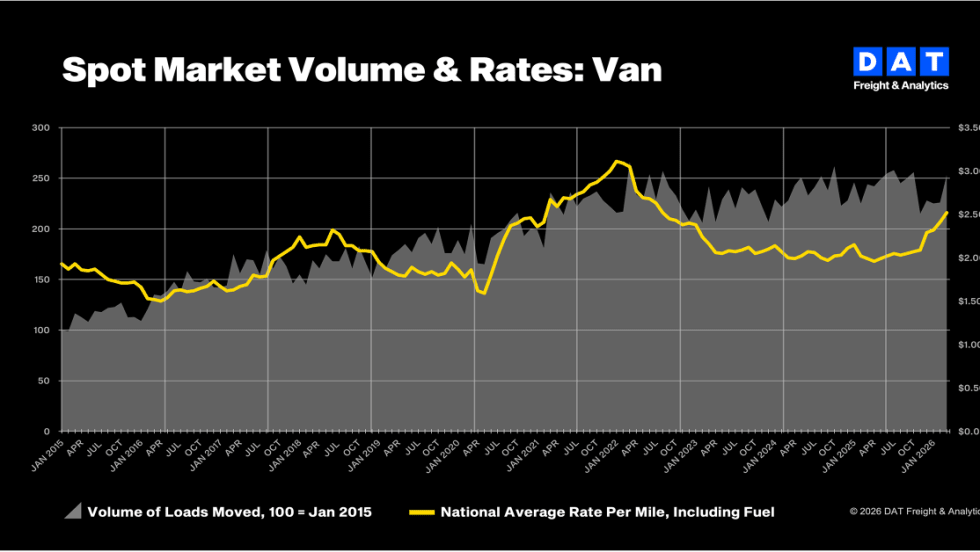
Truckload Rates Hit Two-Year Highs as Diesel Costs Surge, DAT Says
Strong March freight demand combined with a spike in fuel costs pushed both spot and contract truckload rates to their highest levels in more than two years.
Read More →
The AI Conversation You Need to Have with Your TMS Provider
Everyone’s talking about AI — but is your transportation management system actually built for it?
Read More →
Kriska Buys Fellow Canadian Carrier Sharp Transportation Systems
Being part of KTG will allow Sharp to expand and improve its services.
Read More →
Bill in House Would Raise Minimum Insurance for Motor Carriers to $5 Million
The Fair Compensation for Truck Crash Victims Act would increase insurance requirements for interstate motor carriers by nearly seven times.
Read More →
FTR Trucking Conditions Index Hits Four-Year High in February
Strong freight rates push TCI to 10.2, but FTR expects fuel-price volatility to skew March results.
Read More →
C.H. Robinson Offers Carriers Relief as Diesel Prices Surge
C.H. Robinson is waiving fees on fuel cards and cash advances for April and May, aiming to help carriers offset rising diesel costs tied to geopolitical instability.
Read More →