




We noted last year that a number of companies offered advanced technologies designed to improve truck safety, with many of these devices available as factory-installed options or aftermarket products. Not yet widely adopted within the trucking industry, these products were making inroads in specific types of commercial trucking applications – especially with niche carriers that hauled hazardous materials, munitions and other dangerous cargo.
Safety: Just an Option?
Fleets – and not always big fleets – are starting to look to safety systems as damage deterrent devices.
by Jim Beach, Contributing Editor
September 1, 200610 min to read
These technologies, which include stability control, roll-over prevention, collision avoidance, lane departure warning and other systems, integrate with the truck's onboard computer and sensors to warn drivers before they collide with something, suffer a jackknife or rollover.
Increasingly, general freight carriers – and not just the largest fleets – are also spec'ing these technologies as options on new truck orders, or retrofitting existing vehicles under the theory that preventing just one severe accident more than covers the up-front costs.
"We're spending some money on safety technology," says John Plote, equipment director for Stagecoach Cartage, El Paso. "We are trying to be very safety conscious and if it can save us some money in the long run, even though it costs up front, we're doing it."
Stagecoach Cartage, which hauls general freight throughout most of the southern part of the United States, recently ordered 44 new Kenworth T2000s with Eaton's Vorad collision-avoidance system and Bendix's ESP stability control. The company also upfitted some of its existing fleet with the Vorad system. "We haven't put it on our local fleet trucks yet," Plote says.
The Eaton Vorad system uses forward-looking and side radar sensors that alert drivers when they follow the vehicle in front of them too closely or when objects are in a truck's blind spots. Taking account of the truck's speed and load, the system determines how close it is to the vehicle in front and gives visual alerts starting when the vehicles are three seconds apart followed by an audible warning when they are a half-second apart.
Plote says his company also spec'd the SmartCruise component of the Eaton system, which works with a vehicle's cruise control to decelerate, using the engine brake when the truck gets too close to a vehicle in front. Eaton says its studies show fleets see an overall accident reduction of 85 percent when using their system.
Bendix's Electronic Stability Program uses ABS and other sensors that track gearing, vehicle speed and steering angle to determine if a vehicle is approaching a rollover or jackknife situation. The system intervenes and slows the vehicle after a number of checks, which ensures the system intervenes only when warranted.
Plote says he was sold on the Bendix system the first time he drove a truck with the system during a demonstration. Jackknifes, rather than rollovers, are his main concern. "We had a rash of jackknife accidents a few years back and we felt this system could help us with both situations."
For the most part, the drivers at Stagecoach have accepted the new technologies quickly. "With the ESP, the overall acceptance was good," Plote says. "There was a bit of push back with the Vorad until we convinced them we were not going to use it as a report card on them. We're not looking at it as a disciplinary tool. They like the SmartCruise part of it, and that's helped sell it."
The systems have been "an education" for some drivers, Plote adds, saying one driver complained the ESP kicked in when he took one particular curve. "I told him he must be taking the curve too fast and he said he always took the curve at that speed. So I just told him he had always been taking the curve too fast. The sensors just see things they can't."
For Stagecoach, the benefits of the systems seem obvious. "If we eliminate one accident, we pay for the systems," Plote says.
Iteris Inc. and Maverick USA recently announced that Maverick has seen a 65 percent reduction in accidents since it began equipping its fleet with the Iteris lane-departure warning system in 2004. The product alerts drivers when they are crossing over a lane boundary by emitting a virtual rumble strip sound inside the truck cab. The company also introduced a second-generation of the product in March. Iteris says 24 fleets have deployed its product, including Old Dominion Freight Line, which announced plans to install the system on its fleet of 1,200 tractors.
The Iteris system uses a windshield-mounted camera that tracks lane markings and uses image recognition software to monitor the relative position of a truck within the lane. The updated product can generate lane information with only one visible lane marking. If the truck crosses the lane markings, the system emits the rumble strip sound on the appropriate side of the truck.
Combining the features of lane-departure warning and collision-avoidance systems is the goal of AssistWare Technology. The company received a $3-million contract from the U.S. Department of Transportation as part of a $25-million program to test and develop technologies to help drivers avoid crashes. According to the company, both lane-departure and collision-warning systems have proven effective. Combining the two systems represents a "natural evolution."
AssistWare, along with the University of Michigan Transportation Research Institute, Eaton Corp., Visteon Corp., Honda R&D Americas, Battelle Memorial Institute and the Michigan Department of Transportation, will develop, deploy and test an integrated crash-warning system on a fleet of passenger cars and heavy-duty commercial trucks.
AssistWare introduced its lane departure warning system – SafeTrac – in 1999.
Also using a windshield-mounted camera to improve truck safety is a new system from SmartDrive Systems. Introduced in May, this system uses two cameras: one that can record what the driver sees out the windshield and the other that records what's going on inside the cab.
According to Graham Ledger, director of marketing for SmartDrive, there are two main dynamics to the device. One is the camera portion and its ability to record video. The other is the diagnostic capability where the device connects into the truck's onboard computer.
The device consists of two tiny cameras, designed to withstand crashes and extreme g-forces, Ledger says. The cameras record continuously, but only retain video when triggered by an event. "That's how it senses it needs to retain the video." Ledger says. "When it senses a g-force trigger from the left or right, forward or reverse, or some kind of erratic driving event, the video is stored 15 seconds prior to the event and 15 seconds after the event. You can see the applications during a crash, what role this would play in crash reconstruction."
The cameras use wide-angle lenses that are, "not quite 360, but pretty darn close and it can capture a lot of what the driver sees and what happens in the cab as well," Ledger says.
Beyond its capability in accident reconstruction, Ledger says the real benefit of the system is in changing driver behavior. "What we found more than anything else, is that this dovetails into the Hawthorne effect, which was a study done about 100 years ago that found that workers work better when they know they are being watched. We like to say the safety manager is now riding on board once you affix the unit to the windshield.
"We call it behavioral shaping," Ledger adds. "We have the scoring and feedback loop part of the product." This occurs when the camera is triggered to record an event. The video and other information is offloaded wirelessly from the vehicle to the company's secure web site where it is eyeballed by trained reviewers. If the event is something that merits immediate attention from the fleet, the reviewer sends an e-mail to the fleet's safety director. The fleet's safety director can then log onto the web site and view the event and all the diagnostics data as well.
"What we've created is a benchmarking process so you can rate a fleet of drivers against themselves or against the industry," Ledger says. Ledger says the device is being used or tested by some large fleets, one of which has seen a 70 percent drop in erratic driving.
The device can be set for specific g-force triggers according to application. "A border patrol vehicle would be set much higher than an over-the-road truck," Ledger says.
The cost depends upon the size of the installation, Ledger says, with the top price "well below $1,000." A $29 monthly fee includes the review service. The device is marketed for any kind of fleet vehicle from Class 8 trucks to automobiles. "It can be used on any vehicle with a windshield and an onboard computer," Ledger says.
Linking data from onboard computers to communications systems has been a fleet management tool for some time. Virtually all commercial vehicle communications systems, either wireless or satellite-based, can deliver vehicle data such as speed, location and other information. Most often, fleets use this data to improve efficiencies. It can also be used to coach drivers in safer operations.
"Safety and fuel efficiency really go hand in hand," says Joel Beal, senior vice president of Tripmaster Corp. "Aggressive driving is hard on both. Most companies split these things out – fuel efficiency and safety – but in my book, if you drive the way you should to affect one, you'll affect the other."
Tripmaster's device records vehicle speed, acceleration and deceleration rates, engine rpms, mileage and vehicle location, all information a fleet can use to set driver standards that allow them to reward good drivers and identify drivers that need extra training.
Tying all the pieces of information that a fleet can collect into something that can predict driver behavior is what FleetRisk Advisors offers fleets. With offices in Atlanta, Boston and Milwaukee, the company provides predictive analytics and loss control services to the transportation industry. FleetRisk announced in August that it had implemented such a system for Dupre Transport, LLC, located in Manoir Richelieu, Quebec, Canada.
"We are in the business of predicting outcomes," says David Wagner, FleetRisk president. "Trucking is a major application for us."
The basics of FleetRisk's service is to collect data of all kinds relating to a fleet's operations and drivers. "We take any data we can get our hands on," Wagner says. That includes telematics from the various on-board sensors and devices, personnel files, driver profiles and many other sources. From this data, FleetRisk develops a predictive model that divides a fleet's drivers into thirds, with the top third representing the very best drivers and the bottom third representing the drivers that may account for two-thirds of a fleet's accidents.
"This allows a fleet to focus the majority of their resources on just those drivers predicted to have the most incidents," Wagner says. "Instead of trying to work with 600 drivers, say, a fleet can concentrate on just the 200 drivers that need the most work. We don't think fleets will use our lists to release anybody, rather we think they will work with drivers to help them improve their performance."
With Dupre, the system's objective was to combine historical data with current operational data to predict next month's safety performance. FleetRisk integrates information from Dupre's Qualcomm FleetAdvisor fleet management system, Circadian Alertness Simulator, TMW dispatch system, Profile XT, Dupre's internal accident & incident system, Dupre's internal human resources and training programs and internal vehicle and fixed asset systems. That data is combined with external data such as population density, zip code, weather, traffic and other factors to deliver a predictive model.
Wagner says that for fleets with existing databases and other management systems, implementing their system might take 30 days or less. For other fleets, where data sets will have to be developed, implementation could take up to six months.
RYDER, TELETRAC AND CINGULAR CREATE SMART TRUCKS
Ryder System announced in July an alliance with Teletrac and Cingular Wireless to launch RydeSmart, an advanced onboard telematics technology designed to improve vehicle uptime, efficiency, safety and security.
A pilot project including more than 5,000 vehicles is currently under way with the RydeSmart technology.
The RydeSmart is a hardware and software unit installed into a truck that connects to the truck's computer and diagnostics system to track mileage, speed and other performance data. Teletrac's integrated GPS system tracks vehicle location. The data is downloaded to fleet managers every 15 minutes, or as requested, over Cingular's wireless network.
This allows fleet managers to monitor in real time vehicle location, performance, odometer readings and other important data.
Subscribe to Our Newsletter
More Fleet Management

'Beyond Compliance,' Regulations, Driver Coaching on ATRI’s 2026 Research List
The American Transportation Research Institute will examine driver coaching, regulatory impacts — including the "Beyond Compliance" concept —and weather disruptions that shape trucking operations.
Read More →
Fleet Advantage's Brian Antonellis on the Growing Need to Replace Old Trucks
Fleet Advantage's Brian Antonellis says it's time for fleets to get back to the fundamentals of good maintenance practices. And that includes replacing older, inefficient equipment.
Read More →
Truckstop.com Adding to Open Deck, Heavy Haul Offerings
Load matching for flatbed, lowbed, oversize and overweight loads can't be automated like basic van freight, but Truckstop.com is adding more high-tech tools to help.
Read More →
Trucker Path, Truckstop.com Expand Load Access Partnership
An expanded Trucker Path and Truckstop.com integration brings more freight opportunities into the TruckLoads app while emphasizing security and network quality.
Read More →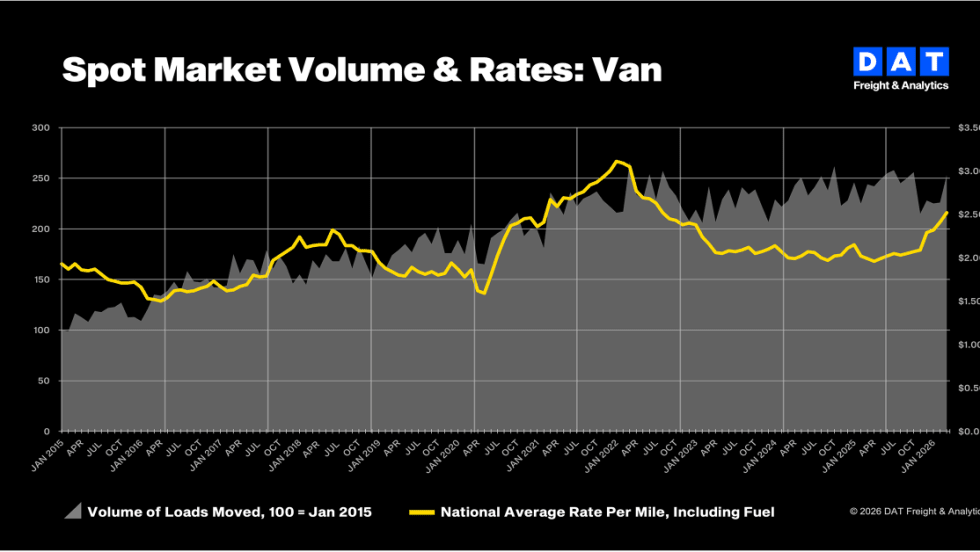
Truckload Rates Hit Two-Year Highs as Diesel Costs Surge, DAT Says
Strong March freight demand combined with a spike in fuel costs pushed both spot and contract truckload rates to their highest levels in more than two years.
Read More →
The AI Conversation You Need to Have with Your TMS Provider
Everyone’s talking about AI — but is your transportation management system actually built for it?
Read More →
Kriska Buys Fellow Canadian Carrier Sharp Transportation Systems
Being part of KTG will allow Sharp to expand and improve its services.
Read More →
Bill in House Would Raise Minimum Insurance for Motor Carriers to $5 Million
The Fair Compensation for Truck Crash Victims Act would increase insurance requirements for interstate motor carriers by nearly seven times.
Read More →
FTR Trucking Conditions Index Hits Four-Year High in February
Strong freight rates push TCI to 10.2, but FTR expects fuel-price volatility to skew March results.
Read More →
C.H. Robinson Offers Carriers Relief as Diesel Prices Surge
C.H. Robinson is waiving fees on fuel cards and cash advances for April and May, aiming to help carriers offset rising diesel costs tied to geopolitical instability.
Read More →