





The hijacking of the Maersk Alabama by Somali pirates and the dramatic rescue of its captain may have captured the nation's attention, but the hijacking and theft of trucks and trailers is a greater threat to the U.S. economy
Security Smarts: Protecting Your Cargo, Trucks and Drivers
The hijacking of the Maersk Alabama by Somali pirates and the dramatic rescue of its captain may have captured the nation's attention, but the hijacking and theft of trucks and trailers is a greater threat to the U.S. econom
August 10, 2009
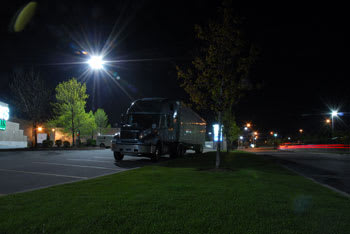
Photo by Jim Park
6 min to read
- and to your company.
But it's not always at the top of the priority list for law enforcement. The general public tends to see it as a victimless crime, notes Susan Chandler, executive director of the American Trucking Associations' Supply Chain Security and Loss Prevention Council.
"If they have to choose between responding to a home invasion where a couple of pieces of jewelry were stolen and a trailer theft where a million dollars in cargo was stolen, which one do you think they're going to choose?"
Cargo theft is attractive to thieves because the risk is low and the payoff is high, and it's an area increasingly dominated by organized crime and gangs.
Increasingly, cargo theft is viewed not just as an issue for those who transport the goods, but as a problem that needs to be dealt with by the supply chain as a whole.
"Cargo theft is a serious, ongoing problem that is very profitable for professional thieves and very costly for organizations throughout the supply chain," says Robert Furtado, CEO of LoJack Supply Chain Integrity. "Especially in today's economic climate, companies cannot afford to pay the exorbitant price tag involved with having their cargoes stolen, which range from the actual value of the goods, to business downtime, to the loss of opportunities to market and sell seasonal goods, to the total loss of product sales."
By the Numbers
It's hard to quantify just how big a problem cargo theft is. Until recently, there was no UCR (Uniform Crime Report) code assigned to cargo theft, so for many law enforcement officers, it was classified under other types of crime. Nevertheless, loss estimates range from $10 billion to $30 billion a year or more.
The true number may be even higher, since some businesses are reluctant to report thefts out of concern for their reputations or their insurance premiums, notes Chief Eric Ives, head of the Major Theft Unit in the FBI's Criminal Investigative Division.
"Estimates are meaningless until your company has experienced a loss," says Tom Chappelear, president, corporate development, of the company Secure Trailer Lots. He notes that the value of a single stolen cargo could range from $15,000 to $3 million.
"Insurance doesn't always pay for it," notes ATA's Chandler. "And for a small operation, one lost load, and that company may be out of business."
LoJack Supply Chain Integrity recently conducted a cargo theft study, based on information the company collected and analyzed from its members in 2008 via its government-sanctioned Supply Chain-Information Sharing and Analysis Center (SC-ISAC).
The data is based on reports provided by SC-ISAC members: more than 1,500 users from nearly 600 organizations who reported a total of 353 incidents in 2008, 299 of them cargo theft. While this is only a fraction of the number of incidents nationwide (in 2007, the California Highway Patrol's Cargo Theft Interdiction Program handled 540 investigations in that state alone), it does offer some insight into trends that seem to mirror what is reported by industry watchers. Texas and Georgia saw the most incidents among the LoJack respondents, with Texas accounting for 32 percent of those reported and Georgia 25 percent.
It's no surprise that the greatest number of thefts occur on the weekends, with the LoJack numbers showing nearly half of the incidents reported - 48 percent - occurring on Saturday and Sunday.
"A lot of theft reports start when the driver drops a trailer full of whatever product and goes home for the weekend," says Nick Erdmann, sales and marketing manager, Transport Security Inc. "Lo and behold, when they come back Sunday night, the trailer's gone."
Economic Effects
There are indications that cargo theft has risen during the recession, or at least the theft of certain types of loads.
"It's hard to say if there's a trend, because the data generally lag behind the events by a couple of years - even longer when you look at official government statistics," says Bill Anderson, group director of global security for Ryder System.
There is, however, a lot of anecdotal evidence that cargo thieves are branching out from the usual high-value loads such as electronics, pharmaceuticals and cigarettes.
"What's kind of unusual right now is they're not picky," says ATA's Chandler. "They're taking anything that's not tied down - appliances, electronics, food products, beverages, clothing, building materials."
In fact, the LoJack SCI study found that food was the most-often stolen cargo in 2008, at 13 percent of the incidents reported, closely followed by pharmaceutical/medical and building supplies, both of which came in at 12 percent.
"According to our analysis of the data, food and drugs are essentials that are always a target of thieves, but especially so in a depressed economy," said Furtado.
Reasons, experts speculate, may be that the recession is causing unemployed people to turn to a life of crime - or it may be that the recession has reduced funding for cargo theft prevention and enforcement efforts. The International Cargo Security Council, for instance, suspended operations the first of this year due to the severe economic situation.
Another factor may be that as some carriers have closed down terminals due to the economy, drivers have fewer secure places to stop, says John Albrecht with Transport Security Inc. At the Truckload Carriers Association's recent Annual Safety and Security Division Conference meeting, he says, companies reported sharp spikes in cargo theft in areas where auto manufacturing and supplier plants had closed down.
"There probably has been a rise in opportunistic theft, where people are perusing truckstops and breaking into trailers to see what's in them," says Ryder's Anderson. "We have had reported incidents of trailers being broken into but nothing being stolen."
There are also some local hot spots, he says, particularly along the U.S./Mexican border, where, as drug-related violence has escalated, the supply chain may be compromised by gangs moving drugs, guns or cash across the border. In this case, he says, carriers and shippers "are not only having to protect their goods against theft, but also the breach of their supply chain security to facilitate contraband being moved across the border." There are stories, he says, of drivers being threatened, of their families being threatened, and thus coerced into participating.
Earlier this year, the Transportation Security Administration's Highway Information Sharing and Analysis Center issued an alert for trucking companies and drivers engaged in cross-border operations within Mexico or whose deliveries take them close to the Mexican border.
"Truck drivers may face an elevated risk of being a crime victim as their loads represent a potentially easy payoff for criminals," says ISAC Director Don L. Rondeau. "We're strongly urging American trucking companies and owner-operators to exercise extreme caution when making deliveries or pick-ups along the Mexican border."
Systematic and Dedicated
Despite the increase in opportunistic theft due to the economy, the main targets are still high-value loads, and the main culprits are gangs and organized crime that operate systematically.
"Organized cargo theft is not a random event," Anderson says. "They know exactly what they're after, what they've been ordered to obtain, and they do their reconnaissance. It's not a random event where they just hijack a truck and see what's inside."
Christopher Parker, technical specialist for motor fleets at Zurich Services Risk Engineering, notes that thieves most often target consumer goods, both high-value and routing
Subscribe to Our Newsletter
More Fleet Management

'Beyond Compliance,' Regulations, Driver Coaching on ATRI’s 2026 Research List
The American Transportation Research Institute will examine driver coaching, regulatory impacts — including the "Beyond Compliance" concept —and weather disruptions that shape trucking operations.
Read More →
Fleet Advantage's Brian Antonellis on the Growing Need to Replace Old Trucks
Fleet Advantage's Brian Antonellis says it's time for fleets to get back to the fundamentals of good maintenance practices. And that includes replacing older, inefficient equipment.
Read More →
Truckstop.com Adding to Open Deck, Heavy Haul Offerings
Load matching for flatbed, lowbed, oversize and overweight loads can't be automated like basic van freight, but Truckstop.com is adding more high-tech tools to help.
Read More →
Trucker Path, Truckstop.com Expand Load Access Partnership
An expanded Trucker Path and Truckstop.com integration brings more freight opportunities into the TruckLoads app while emphasizing security and network quality.
Read More →
Truckload Rates Hit Two-Year Highs as Diesel Costs Surge, DAT Says
Strong March freight demand combined with a spike in fuel costs pushed both spot and contract truckload rates to their highest levels in more than two years.
Read More →
The AI Conversation You Need to Have with Your TMS Provider
Everyone’s talking about AI — but is your transportation management system actually built for it?
Read More →
Kriska Buys Fellow Canadian Carrier Sharp Transportation Systems
Being part of KTG will allow Sharp to expand and improve its services.
Read More →
Bill in House Would Raise Minimum Insurance for Motor Carriers to $5 Million
The Fair Compensation for Truck Crash Victims Act would increase insurance requirements for interstate motor carriers by nearly seven times.
Read More →
FTR Trucking Conditions Index Hits Four-Year High in February
Strong freight rates push TCI to 10.2, but FTR expects fuel-price volatility to skew March results.
Read More →
C.H. Robinson Offers Carriers Relief as Diesel Prices Surge
C.H. Robinson is waiving fees on fuel cards and cash advances for April and May, aiming to help carriers offset rising diesel costs tied to geopolitical instability.
Read More →