




Past predictions of future technology called for flying cars and personal robots. Yet the biggest leaps in technology have probably been in communications, and trucking is no exception.
Telematics: The Next Frontier
Past predictions of future technology called for flying cars and personal robots. Yet the biggest leaps in technology have probably been in communications, and trucking is no exception
by Genevieve Conti, Assistant Editor
May 21, 2012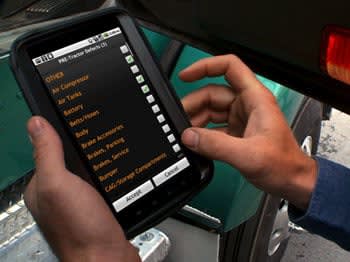
Tablets are increasing in popularity with fleets as part of telematics systems. Here, Xata's tablet captures information from a pre-trip inspection, which is then sent to a back office.
6 min to read

Flying cars may still be the province of "The Jetsons," but truck telematics have dramatically changed the way fleets communicate with and manage trucks and drivers - and there's more to come.
Cashing in on lower costs
Implementing a telematics system will no longer break the bank, and the prices are only going to keep coming down.
"Prices have come down so much, and communication plans are reasonable," says Keith Steidle, customer information systems manager for Automotive Resources International. "The ROI can be proven. It's just really taking steps to manage the information and track it."
The cost of a telematics system includes the hardware component (the technology installed in the truck) and a monthly fee. Just as the price of personal computers has dropped significantly, so has the price of telematics hardware.
"You can go buy [a personal computer] for $500 to $600 now that probably would have powered NASA 30 years ago," says Norm Ellis, vice president sales, services and marketing Qualcomm Enterprise Services.
When Qualcomm first offered its OmniTracs system in 1987, the hardware cost $4,500 per truck, with a $50-a-month service fee for satellite connection. "That's a lot of money today, and it certainly was in 1987," Ellis says. Today, the company's newly released fleet management solution, the MCP50, has a suggested retail price of $799 and monthly service charges as low as $19.95.

Today's lower prices may still be too much, says Sandeep Kar, global director of commercial vehicle research for industry research firm Frost & Sullivan. "Fleets are operating under razor-thin margins," he says. "Prices need to come down a little bit more to become more affordable to a broader segment of the commercial vehicle market."
Kar says the value needs to resonate with smaller fleets. When that happens, probably around 2015 or 2016, he says, the telematics market will gain momentum.
Another driver of lower costs is the decreasing cost of data with the introduction of 3G and 4G cellular networks. "The advent of the terrestrial network certainly is huge because we're not talking to a satellite any longer for communication," Ellis says.
As costs come down, says Joel Beal, COO for EOBR Max, there will be much less focus on the hardware installed in the truck and more focus on the information we get from it. "I really think that box, in five years, will be just another device," he says. "It will have the same significance to me as the little server sitting under my desk."
Internet connectivity
The next wave of telematics technology will see increased Internet connectivity, which will be especially helpful in keeping drivers on "the grid."
WiFi, combined with 4G, allows for enormous amounts of data to be passed back and forth from a truck or driver to the back office, says PeopleNet President Brian McLaughlin.
"Basically, we now have an always-on, high-bandwidth communications network that allows for Web browsing when you're on the road," he says. "You can now offer drivers access to all types of information. Maybe it's payroll, maybe it's safety-training videos. It's a great way to keep connected to drivers."
Access to training on the road benefits both fleets and drivers, says Qualcomm's Ellis. "If a driver is going to wait for 45 minutes at a stop for pickup, that counts against total driving time for the day. If he could take a training video while he's there, he's being productive with that 45 minutes, so when he does come home, he just goes and sees his family."
Internet connectivity will bring with it a host of device options for driver use. Dan Popkin, vice president, business development of enterprise solutions, ALK Technologies, says consumer tablets and smartphones we see today will have a big effect on what's introduced in the commercial vehicle segment.
"So many of these drivers, when they go home at night, might be using Android or Apple's iPhone," Popkin says. "It's changing the expectations of the traditional business telematics end user in terms of what an enterprise solution looks like, how sexy it is, and how intuitive and easy it is to use. It will be very interesting to watch over the next 12 to 24 months what hardware trends are within this space."
Despite its appearance in more than one concept truck recently, Apple's iPad is not something you're likely to see installed in a truck, says McLaughlin, because the devices need to be ruggedized. Such ruggedized devices are what several companies, including McLaughlin's, are starting to offer. "Consumer-grade tablets aren't a viable option for commercial vehicle telematics," he says. "The devices need to be able to withstand rigors such as vibration, dust and shock."
Predicting the future
Predictive analytics (also referred to as prognostics, remote diagnostics or predictive diagnostics) is a term you'll hear a lot, if you aren't already.
Essentially, it's taking historical data of any kind, from engine data to the weather, and predicting what will happen next for that driver, vehicle or fleet.
The term prognostics refers specifically to predicting engine or mechanical failures.
We already use this same basic technology for things such as roll stability control, says Paul Menig, CEO of consulting company Tech-I-M. Soon, he says, we'll see an increase in the information coming from the truck itself.
"Our techniques to analyze engine oil to determine when it should be changed tends to be off-board the vehicle today, but someday there will be sensors that are on-board" to measure that, Menig says.
This is valuable to fleets because it can significantly reduce downtime.
"When vehicles face downtime, the fleets bleed revenues," says Frost & Sullivan's Kar. "Prognostics helps prevent that. It can tell you an impending failure is about to happen in 500 miles or 200 miles, for example, unless you correct it right now."
Predictive analytics tends to refer more to predicting driver behavior such as which drivers are more likely to have accidents. It can use driver patterns, traffic information, weather and even information about a driver's lifestyle to give fleets insight into driver behavior and the likeliness of accidents.
"It's not quite optimized as of now, but there is tremendous demand from fleet managers for this technology," Kar says. In a survey, Frost & Sullivan asked 100 fleet managers if they would rather pay $6 per month per truck for back office automation applications or $12 per month per truck to add prognostics. Even in a recessionary environment, 50% said they'd rather have the prognostics.
OEMs get in on the action
Look for increased involvement in telematics from OEMs, mainly because more engine information will help develop more complex prognostics that can provide fleets with much more information.
In the past, we've seen different manufacturers get in and out of the telematics game. Some create their own systems; others prewire trucks for easy upfit after the fact.
"Everything we hear and understand is that in the next five to 10 years, telematics will come from the factory," ARI's Steidle says. "Right now, it seems like they're doing a lot of it in the aftermarket or at an upfitter. Some providers of telematics devices have been courting the manufacturers."
Qualcomm's Ellis has a clear picture of what this could mean in the future. "Let's say a truck is going down the road and senses the fuel pump is going to go out. An alert would go to the fleet and to the OEM saying you have a truck 30 miles from Cincinna
Subscribe to Our Newsletter
More Fleet Management

'Beyond Compliance,' Regulations, Driver Coaching on ATRI’s 2026 Research List
The American Transportation Research Institute will examine driver coaching, regulatory impacts — including the "Beyond Compliance" concept —and weather disruptions that shape trucking operations.
Read More →
Fleet Advantage's Brian Antonellis on the Growing Need to Replace Old Trucks
Fleet Advantage's Brian Antonellis says it's time for fleets to get back to the fundamentals of good maintenance practices. And that includes replacing older, inefficient equipment.
Read More →
Truckstop.com Adding to Open Deck, Heavy Haul Offerings
Load matching for flatbed, lowbed, oversize and overweight loads can't be automated like basic van freight, but Truckstop.com is adding more high-tech tools to help.
Read More →
Trucker Path, Truckstop.com Expand Load Access Partnership
An expanded Trucker Path and Truckstop.com integration brings more freight opportunities into the TruckLoads app while emphasizing security and network quality.
Read More →
Truckload Rates Hit Two-Year Highs as Diesel Costs Surge, DAT Says
Strong March freight demand combined with a spike in fuel costs pushed both spot and contract truckload rates to their highest levels in more than two years.
Read More →
The AI Conversation You Need to Have with Your TMS Provider
Everyone’s talking about AI — but is your transportation management system actually built for it?
Read More →
Kriska Buys Fellow Canadian Carrier Sharp Transportation Systems
Being part of KTG will allow Sharp to expand and improve its services.
Read More →
Bill in House Would Raise Minimum Insurance for Motor Carriers to $5 Million
The Fair Compensation for Truck Crash Victims Act would increase insurance requirements for interstate motor carriers by nearly seven times.
Read More →
FTR Trucking Conditions Index Hits Four-Year High in February
Strong freight rates push TCI to 10.2, but FTR expects fuel-price volatility to skew March results.
Read More →
C.H. Robinson Offers Carriers Relief as Diesel Prices Surge
C.H. Robinson is waiving fees on fuel cards and cash advances for April and May, aiming to help carriers offset rising diesel costs tied to geopolitical instability.
Read More →