




Many shippers and transporters of hazardous materials are familiar with the small orange Emergency Response Guidebook. Most associate the ERG with compliance with the Hazardous Materials Regulations (49 CFR), using it to provide emergency response information for a hazardous materials shipment. Yet that is not why the ERG was created.
The Purpose of the Emergency Response Guidebook
Many shippers and transporters of hazardous materials are familiar with the small orange Emergency Response Guidebook. Most associate the ERG with compliance with the Hazardous Materials Regulations (49 CFR), using it to provide emergency response information for a hazardous materials shipment. Yet that is not why the ERG was created
by Thomas Ziebell, Contributor
December 19, 2011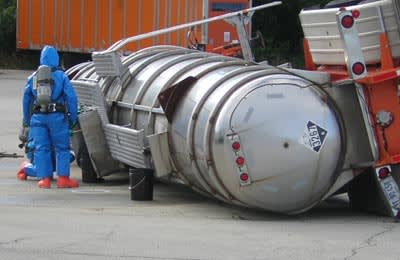
The scenario was part of a Schneider National exercise for hazardous materials responders, but in real life, many carriers keep a current Emergency Guidebook in their trucks to comply with hazmat regulations.
3 min to read
The Emergency Response Guidebook originally was developed by the U.S. Department of Transportation, Transport Canada and the Secretariat of Transport and Communications of Mexico for use by police, firefighters and other emergency personnel who are the first to arrive at the scene of a transportation incident involving hazardous materials/dangerous goods. The ERG helps first responders quickly identify the hazard(s) of the materials and protect themselves and the general public during the initial response phase of an incident.
The "initial response phase" is the period following the first responders' arrival at the scene, during which the presence and/or identification of hazardous materials is confirmed, protective actions and area securement are initiated, and assistance of qualified personnel is requested.
The DOT distributes copies of the ERG to emergency responders throughout the U.S. The goal is to have one available to every emergency responder in the country. Occupational Safety and Health Administration and Environmental Protection Agency regulations require that first responders be trained on the use of the ERG.
So why do I need one?
To increase the likelihood that emergency response information will be available to first responders at the scene of a hazardous materials incident, the Hazardous Materials Regulations require that emergency response information accompany most shipments of hazardous materials. (Emergency response information is not required for hazardous materials that do not require shipping papers or are classified as an ORM-D.)
The emergency response information can be provided in several ways:
- It can be entered on the hazmat shipping papers; or
- It can be provided in another document, other than the shipping paper, that includes the basic description (and technical name if appropriate) of the hazardous material. A Material Safety Data Sheet is an example of this type of document; or
- It can be provided in a separate document, other than the shipping paper, that cross-references the description of the hazardous material on the shipping paper with the emergency response information contained in the document. The ERG is an example of this type of document.
Carriers that transport hazardous materials must maintain the emergency response information the same as they do shipping papers. The emergency response information must be readily available to, and recognizable by, authorities in the event of an incident or inspection.
Although not the original intended use for the ERG, keeping an ERG with the hazmat shipping papers is an easy way to comply with the emergency response information requirements in the Hazardous Materials Regulations. Many carriers play it safe and carry an ERG in their vehicles to cover any hazmat load/situation they may encounter.
The ERG is updated and issued every four years by DOT's Pipeline and Hazardous Materials Safety Administration. The next edition, the 2012 ERG, is anticipated to be released in early 2012. Anyone who works with hazardous materials will want the new 2012 ERG to be sure they have the latest emergency response information.
Thomas Ziebell is a senior editor, Hazardous Materials Transportation for J.J. Keller & Associates.
From the December 2011 issue of HDT.
Subscribe to Our Newsletter
More Safety & Compliance

'Beyond Compliance,' Regulations, Driver Coaching on ATRI’s 2026 Research List
The American Transportation Research Institute will examine driver coaching, regulatory impacts — including the "Beyond Compliance" concept —and weather disruptions that shape trucking operations.
Read More →
FMCSA Revamps DataQs to Improve Fairness, Speed of Reviews
New requirements add firm deadlines and independent review steps, addressing long-standing complaints about inconsistent rulings and slow response times.
Read More →
FMCSA Extends Paper Medical Card Exemption … Again
Five states still aren't ready to accept commercial driver medical exam information directly from the medical examiner's registry.
Read More →
HDT Honors the Best New Products of 2025 at TMC [Photos]
Heavy Duty Trucking's Top 20 Products awards recognize the best new products and technologies. Check out the award presentations at the 2026 Technology & Maintenance Council annual meeting.
Read More →
Sponsored•March 31, 2026
Detroit Engines: Trusted Performance, Built for What's Next
The Detroit® Gen 6 engine platform proves that real progress doesn’t require a complete redesign. Built on 20 years of trusted technology, these engines are designed for efficiency, stronger performance, and greater reliability than before. And they do it all while complying with 2027 EPA standards on every mile.
Read More →
Aperia Expands Halo Platform with Steer-Tire Inflation System, Fifth-Wheel Integration
Aperia Technologies introduced a new automatic tire inflation system for steer axles and a partnership with Fontaine Fifth Wheel to integrate coupling status into its Halo Connect platform.
Read More →
Fleetworthy and HAAS Alert Expand Partnership Stopped Truck Protection Alerts
Fleetworthy and HAAS Alert expanded their partnership to deliver real-time digital alerts that warn motorists when commercial trucks are stopped roadside and notify truck drivers when approaching emergency responders.
Read More →
New Entrants, Chameleon Carriers, and Safety: Is It Too Easy to Start a Trucking Company?
More than 100,000 new trucking companies enter the industry each year, but regulators manage to audit only a fraction of them. That churn creates opportunities for inexperienced startups — and for “chameleon carriers” that shut down after safety violations and reappear under new identities. Read more from Deborah Lockridge in this commentary.
Read More →
Mack Introduces Mack Protect Collision Mitigation System for MD Series
Mack Trucks has expanded its proprietary Mack Protect collision mitigation platform to the Mack MD Series, bringing heavy-duty safety technology to medium-duty trucks operating in urban and regional environments.
Read More →
Bison Transport, Mill Creek Motor Freight Win TCA Fleet Safety Awards Grand Prize
Two Canadian fleets earned the Grand Prize in the Truckload Carriers Association’s 2025 Fleet Safety Awards, recognizing the industry’s top safety performance based on accident frequency and safety programs.
Read More →