





ACT Research reports the supply and demand dynamics in the freight market are beginning to recover. Its recent data suggests demand fundamentals improving and capacity starting to tighten may signal the industry is approaching the bottom of the freight cycle.
Are We Near the Bottom of the Freight Cycle?
ACT Research reports the supply and demand dynamics in the freight market are beginning to recover. Its recent data suggests demand fundamentals improving and capacity starting to tighten may signal the industry is approaching the bottom of the freight cycle.
May 22, 2023

Supply and demand numbers indicate the freight cycle is approaching the bottom.
Source: ACT Research/Cass Information Systems/Canva
4 min to read
“After a long soft patch, we see the U.S. freight transportation industry on the verge of a new cycle as we begin to transition from the bottoming phase into the early phase of the freight cycle in the months to come,” Tim Denoyer, ACT Research’s vice president and senior analyst, said in the Cass Transportation Index Report April 2023.
The latest release of the ACT Freight Forecast report points out that the freight cycle is “still weak” and truckload spot rates are nearing the bottom.
Truckload Volume Index
According to the Truckload Volume Index, freight volumes dropped and national average spot rates for dry van and refrigerated loads fell for the fourth consecutive month in April, said DAT Freight & Analytics.
Van TVI was 206, down 15.5% from March and 12.3% lower year over year.
Reefer TVI fell to 154, a 16.3% decline from March and 12.5% lower year over year.
Flatbed TVI was 239, 13.7% lower compared to March but 3.5% higher year over year.
DAT also reported the national average load-to-truck ratios decreased, indicating weaker demand for truckload capacity on the spot market.
Van ratio: 1.9, down from 2.0 in March, and 3.4 in April 2022.
Reefer ratio: 2.7, down from 3.0 in March and 6.3 year over year.
Flatbed ratio: 12.1, down from 12.1 in March and 64.5 year over year.
According to DAT, this lower demand for truckload services led to a drop in national average spot van and reefer rates:
The spot van rate averaged $2.06 per mile, down 10 cents compared to March and 71 cents lower year over year.
The spot reefer rate fell 9 cents to $2.41 a mile, 72 cents lower than in April 2022.
The spot flatbed rate dipped 4 cents to $2.67 a mile, down 70 cents year over year.
Cass Freight Index
The Cass Freight Index shows shipments declined 2.4% in April when compared to the same period last year. Data within the Index includes all domestic freight modes and is derived from 36 million invoices and $44 billion in spend processed by Cass annually on behalf of its client base of hundreds of large shippers. The diversity of shippers and aggregate volume provide a statistically valid representation of North American shipping activity, according to Cass.
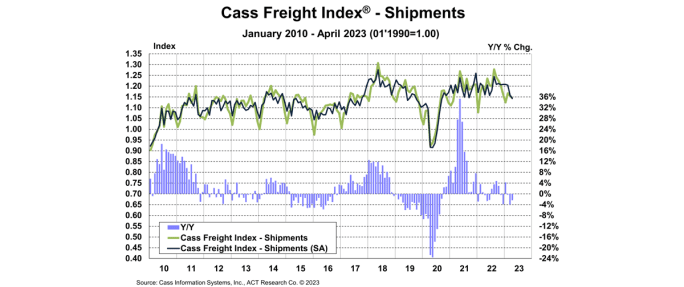
The shipments component of the Cass Freight Index fell 2.4% in April compared to the previous period last year.
Source: ACT Research/Cass Information Systems
According to the report, warm weather appears to have pulled some freight shipments into January and February instead of shipping in March and April. When seasonally adjusted, the index declined 1.3% from month to month in April, which followed a 3.8% drop in March.
“With produce season arriving late this year and the freight market likely passing the peak of the destock, freight demand is near the bottom,” said Denoyer. “With inflation easing, improving real income trends will allow for a bit more holiday spending this year, when even less destocking will mean more freight volume.”
Fleet Capacity
Regarding fleet capacity, Denoyer explained, “Interstate operating authorities are contracting at a record rate, with about 11,000 net revocations since last October, including about 1,600 net revocations in April. Total revocations were about 10,800 in April, near record levels, but grants and reinstatements are also elevated. This is beginning to tighten capacity, which will also help spot rates find the bottom and begin to rise.”
He also pointed out long-distance trucking employment is contracting, as reflected in a first-quarter decline of 8,700 jobs. Those numbers marked a 1.0% decrease; however, driver employment numbers were still up 3.0% year over year in that latest March data point. Denoyer said the series will be down on a year-over-year basis by June on its current level. Denoyer also said since trends in employment follow trends in freight rates, long-haul jobs are set to decline this year.
Denoyer concluded, “The intersection of additional volume and tightening capacity underpins our forecast for a near-term bottom in spot truckload rates. We’ve been expecting the bottom roughly around this month since we introduced 2023 spot rate forecasts 16 months ago, and we still think RoadCheck this week will help usher in a new freight cycle.”
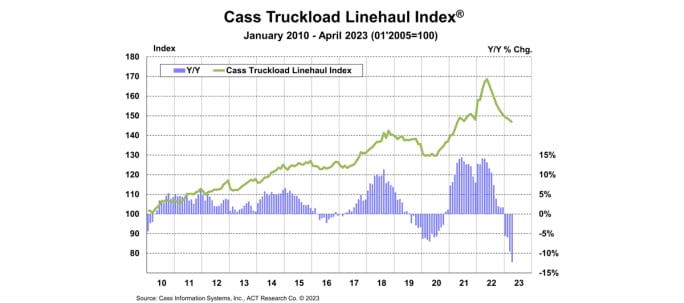
The Cass Truckload Linehaul Index fell 12.3% in April compared to last year, following declines in March.
Source: ACT Research/Cass Information Systems
Topics:Fleet Management
More Fleet Management

'Beyond Compliance,' Regulations, Driver Coaching on ATRI’s 2026 Research List
The American Transportation Research Institute will examine driver coaching, regulatory impacts — including the "Beyond Compliance" concept —and weather disruptions that shape trucking operations.
Read More →
Fleet Advantage's Brian Antonellis on the Growing Need to Replace Old Trucks
Fleet Advantage's Brian Antonellis says it's time for fleets to get back to the fundamentals of good maintenance practices. And that includes replacing older, inefficient equipment.
Read More →
Truckstop.com Adding to Open Deck, Heavy Haul Offerings
Load matching for flatbed, lowbed, oversize and overweight loads can't be automated like basic van freight, but Truckstop.com is adding more high-tech tools to help.
Read More →
Trucker Path, Truckstop.com Expand Load Access Partnership
An expanded Trucker Path and Truckstop.com integration brings more freight opportunities into the TruckLoads app while emphasizing security and network quality.
Read More →
Truckload Rates Hit Two-Year Highs as Diesel Costs Surge, DAT Says
Strong March freight demand combined with a spike in fuel costs pushed both spot and contract truckload rates to their highest levels in more than two years.
Read More →
The AI Conversation You Need to Have with Your TMS Provider
Everyone’s talking about AI — but is your transportation management system actually built for it?
Read More →
Kriska Buys Fellow Canadian Carrier Sharp Transportation Systems
Being part of KTG will allow Sharp to expand and improve its services.
Read More →
Bill in House Would Raise Minimum Insurance for Motor Carriers to $5 Million
The Fair Compensation for Truck Crash Victims Act would increase insurance requirements for interstate motor carriers by nearly seven times.
Read More →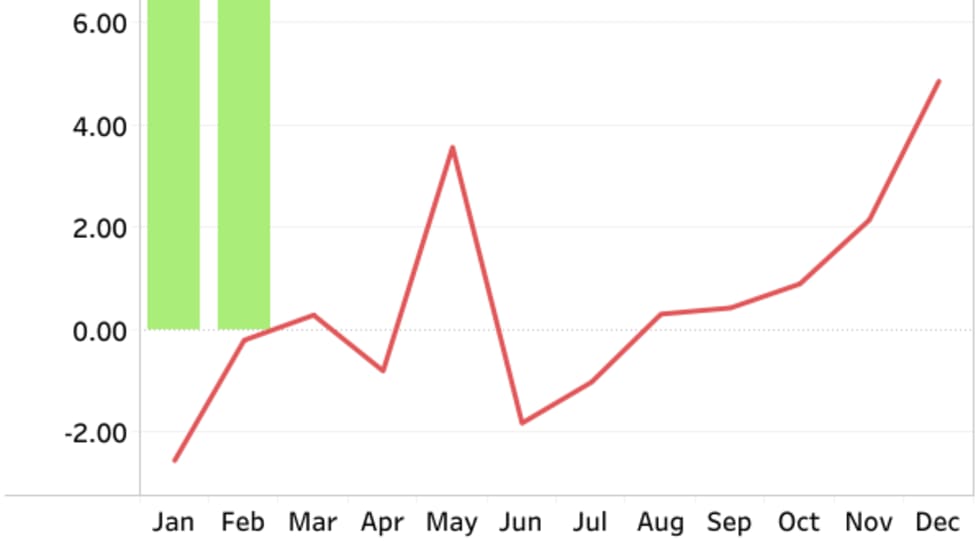
FTR Trucking Conditions Index Hits Four-Year High in February
Strong freight rates push TCI to 10.2, but FTR expects fuel-price volatility to skew March results.
Read More →
C.H. Robinson Offers Carriers Relief as Diesel Prices Surge
C.H. Robinson is waiving fees on fuel cards and cash advances for April and May, aiming to help carriers offset rising diesel costs tied to geopolitical instability.
Read More →