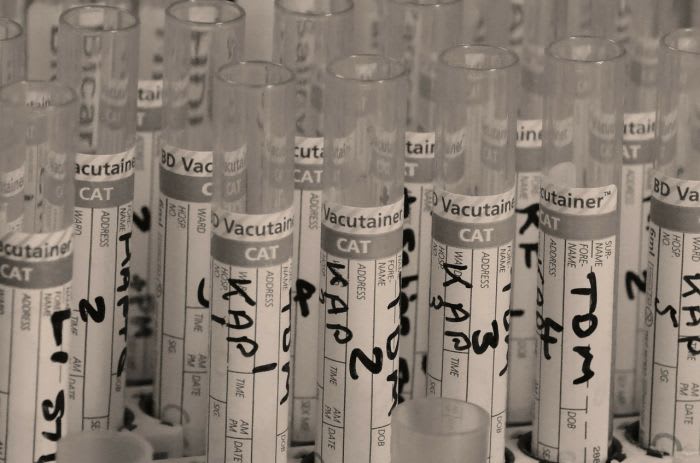
Bipartisan legislation was introduced in Congress today that would allow the Department of Transportation to recognize hair testing as an alternative option to give companies greater flexibility when conducting drug and alcohol testing.
David Cullen・[Former] Business/Washington Contributing Editor
U.S. Senators John Boozman (R-AR) and Joe Manchin (D-WV) today introduced bipartisan legislation that would allow the Department of Transportation “to recognize hair testing as an alternative option to give companies greater flexibility when conducting drug and alcohol testing,” according to a news release issued by the Senate.
Ad Loading...
The Drug Free Commercial Driver Act of 2015is also cosponsored by Senator Heidi Heitkamp (D-ND). Companion legislation was introduced as well in the House by Rep. Rick Crawford (R-AR) and cosponsored by Rep. Rick Crawford (R-Ark.), Rep. Dan Lipinski (D-IL), and Del. Eleanor Holmes Norton (D-DC)
And while some employers already use hair testing for their own purposes, the federal government requires that duplicative urinalysis testing also take place.
For example, from May 2006 to December 2014, stated the Senate news release, J.B. Hunt Transport’s drug-testing data found that 110 driver applicants failed the urine test while 3,845 people had drug-positive hair test results. In addition, Schneider National’s pre-employment drug testing data from March 2008 to June 2012 found 120 prospective drivers failed the urine test while 1,400 applicants had drug-positive hair test results. The upshot is that under current law, trucking companies that elect to use hair testing to gain more accurate test results must bear the added cost of administering both types of testing.
“Preventing drug users from operating commercial trucks will improve safety on our roads and enhance industry standards,” said Sen. Boozman. “This legislation eliminates the duplicative drug-testing process and allows trucking companies to use the more effective option, without having to pay for two tests.”
“Americans rely every day on the safety of our roads and highways as they commute to their jobs, travel to schools and recreational activities, and transport goods and products across the country,” Sen. Manchin said. “That is why this commonsense legislation is so important. By allowing companies to use more accurate alcohol and drug testing techniques to test those operating commercial vehicles, we will not only help combat the fight against substance abuse, but we will also help improve the safety of our roads.”
Ad Loading...
“My bill’s only concern is improving the safety of our roads,” Rep. Crawford said. “Some drug users, when they know that a drug test is likely, are able to abstain for just a few days before the test and beat the system. This bill would catch a much larger percentage of those drivers and keep them off the roads. As a member of the Transportation and Infrastructure Committee, I’m always looking for ways to improve roadway safety, and this bill helps tackle that problem.”
Both the Alliance for Driver Safety & Security (a.k.a. the Trucking Alliance) and the American Trucking Associations lauded the bipartisan measure aimed at improving the trucking industry’s pre-employment drug screening process.
Referencing the J.B. Hunt hair vs urine test results, Lane Kidd, managing director for the Trucking Alliance, noted that “this statistic is alarming because while J.B. Hunt was able to avoid putting these drug users in a commercial truck, many of them are likely driving a commercial truck somewhere today for a company that only utilizes a urine test.”
ATA is urging lawmakers to support this bipartisan legislation as it would “allow trucking companies to use a highly effective tool-- hair testing-- to meet federal requirements and prevent drug users from getting behind the wheel of trucks.”
"ATA is committed to improving highway safety, including doing all we can to prevent individuals who use drugs or alcohol from driving trucks," said ATA president and CEO Bill Graves. "ATA's advocacy [of mandatory drug and alcohol testing] has resulted in a steady decline in the small percentage of drivers who use drugs, and hair testing is the next logical step."
Ad Loading...
Graves added that while “trucking’s positive testing rate is remarkably low, Congress should provide a means for fleets, as part of the DOT testing regime, to further identify and eliminate from the industry those who don't share the industry's commitment to highway safety."
According to ATA, some fleets voluntarily conduct hair tests, in addition to mandatory urine tests, to identify habitual drug users who may otherwise briefly abstain from use or otherwise attempt to “beat the test” to gain trucking employment.
The trucking lobby noted that in 2008 the Government Accountability Office “highlighted the severity of these limitations in DOT’s current urine drug testing program.”
But because hair tests have not yet been accepted by DOT to meet federal testing requirements, other fleets have been deterred by the redundant costs of employing hair testing programs in addition to the required DOT urine-based tests, ATA stated.
Hair-specimen testing proponents say such screening provides a significantly longer detection window, is very difficult to adulterate, and eliminates collection issues associated with urine. As a result, hair testing has consistently identified over three times as many illegal substance users as urine testing in regulated industry pre-employment trial programs.
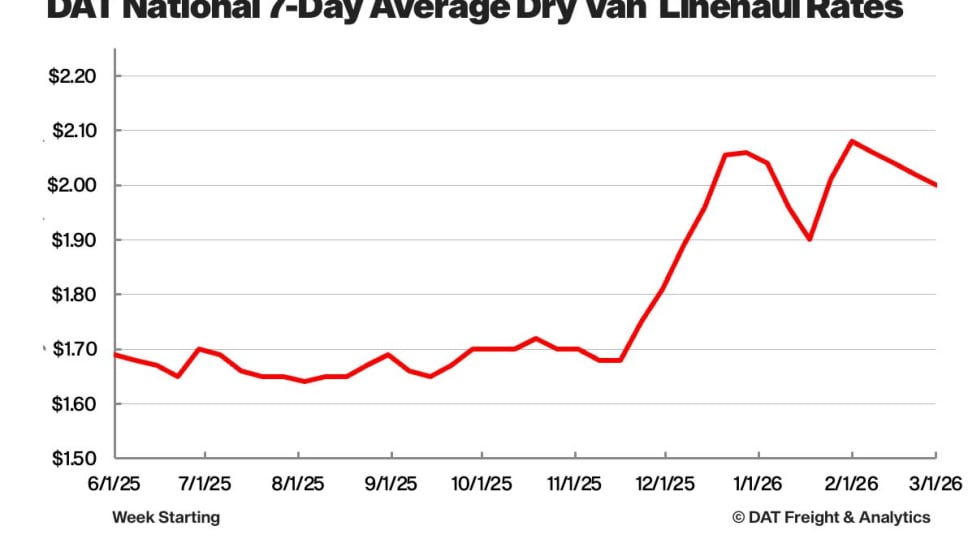
ACT Research data shows volumes hitting a four-year high and supply-demand balance strengthening, but higher oil prices are undercutting tariff relief and tempering optimism.
The patent-pending cargo solution integrates a digitally connected cargo door and an intelligent locking system with the TrailerHawk.AI technology platform.
Speaking at the TMC Annual Meeting in Nashville, ATA President Chris Spear said trucking faces mounting pressure from rising fuel prices, geopolitical instability, and uncertainty around trade policy.
More than 100,000 new trucking companies enter the industry each year, but regulators manage to audit only a fraction of them. That churn creates opportunities for inexperienced startups — and for “chameleon carriers” that shut down after safety violations and reappear under new identities. Read more from Deborah Lockridge in this commentary.
HDTX is an intimate event that connects heavy-duty trucking fleet managers with industry suppliers through small-group discussions, educational sessions, and structured one-on-one meetings.
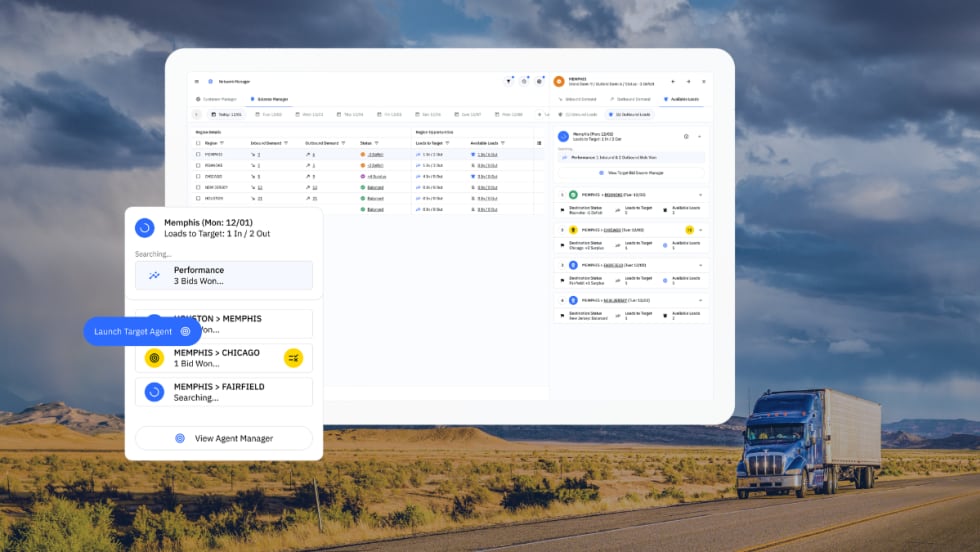
Optimal Dynamics says its new Scale platform uses AI agents and optimization to help carriers find and secure freight that improves network balance and profitability.
NACFE's Run on Less - Messy Middle project demonstrates the power of data in helping to guide the future of alternative fuels and powertrains for heavy-duty trucks.