




While fears of a double-dip recession are easing, GDP and industrial production numbers suggest 2012 will not be as robust as 2011. As recently as June, economists were predicting growth of 3 to 3.5 percent for 2012, but new consensus forecasts are calling for growth of just 2 to 2.5 percent. That one percentage point drop means we may need about 20,000 fewer new trucks this year.
Brace for a Slowdown in 2012
While fears of a double-dip recession are easing, GDP and industrial production numbers suggest 2012 will not be as robust as 2011. As recently as June, economists were predicting growth of 3 to 3.5 percent for 2012, but new consensus forecasts are calling for growth of just 2 to 2.5 percent. That one percentage point drop means we may need about 20,000 fewer new trucks this year
by Staff
February 1, 2012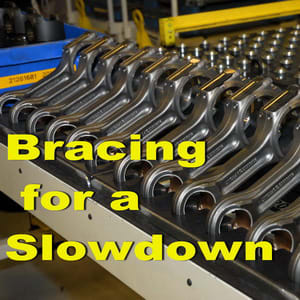
Truck production in 2012 could be lower than predicted because of downward revisions in GDP forecasts.
4 min to read
Speaking at Heavy Duty Dialog last week in Las Vegas, part of the proceedings at heavy Duty Aftermarket Week, economist, Eli Lustgarten, Senior vice president at Longbow Securities, predicted that 2012 would be a healthy year overall -- and on par with previous post-recession recovery periods -- but he cautioned that we will not witness the same performance we saw last year.
"The economic climate here was great for a recovery in 2011. We had very strong productivity coming out of the recession, and negative labor costs. It was a perfect combination for productivity," he says. "Company's margins were spectacular coming back from 2009 and we saw great profits, but we're starting to come out of that cycle in 2012."
Lustgarten calls it the Bullwhip Effect.
During the downturn, people just cut everything back and shut down, he says. Inventory dropped to unimaginable levels and mathematically, about $180 billion in inventory disappeared from the system. Coming out the other side, there was a rebalancing and restocking of the supply chain, which produced a significant improvement in economic performance compared to 2009, but in 2010, manufacturing output remained about 30 percent below pre-recession levels.
In 2011, inventory levels in many sectors started rising to levels commensurate with the economic climate, but not back to where they were 24 to 30 months prior.
"That was still a huge swing, and we saw a huge change in production and that produced a huge change in inventory levels," Lustgarten pointed out. "In 2012, we'll be looking for the new normal. But that level will be below where we came from in the 2006 to 2008 period when new home construction peaked, along with automotive, heavy truck and construction equipment manufacturing.
Manufacturing was very strong in 2010, and while the industrial sector was one of the leading drivers in the U.S. recovery, consumer and business confidence levels remained weak, and tight credit continued to hamper growth in the small business sector. Slow housing and commercial construction growth stymied the recovery of the construction sector.
But while manufacturing is important, what really counts is the way GDP affects the industrial economy, he said. "Industrial production is a key driver of the industrial economy and the manufacturing side, and they are key drivers for the truck market."
Lustgarten says 2011 came in just under 2 percent GDP growth, and as recently as six months ago, economists were predicting growth of between 3 to 3.5 percent for 2012. It now appears those numbers were a little optimistic. The consensus forecast for 2012 is now in the 2 to 2.5 percent range. For truck fleets, that one percentage point spread is significant -- as it is for truck manufacturing.
Building for Demand
If you believe GDP is running at 2 to 2.5 percent, you're going to believe industrial production is also going to be in the mid-twos. If you believe the economy is going to run at 3 to 3.5 percent, then industrial production is going to be 3.5 to 4 percent. What's the difference?
"At about 2.5 percent growth in industrial production, truck fleets are stabilized. You buy for replacement, but you really don't expand the fleet," says Lustgarten. "When you get to 3.5 to 4 percent GDP and industrial production numbers, you begin to expand fleets."
In real terms, a small swing in GDP or industrial production is going to create significant swings in estimated demand, and that will create significant variations in build rates.
Towards the end of 2011, Q4 build rates accelerated, and that growth seemed to be driven by a quiet pre-buy of fleets looking a cashing in on a depreciation credit that expired at the end of the year, and by fears of price hikes in 2012. The extent to which that skewed the demand/production numbers was not great, but Lustgarten says.
"There was clear evidence of a surge in heavy truck demand in December, with final production estimates for 2011 expected to be 255,000 units," he notes.
Based on 2011 production numbers and Q4 numbers in particular, with new estimates on the 2012 GDP growth revised downward to 2 to 2-5 percent from 3 to 3.5 percent, recent truck production estimates could off by as many as 20,000 units, Lustgarten said.
If GDP for 2012 can be sustained at 3 percent, we could see as many as 300,000 Class 8 trucks roll of assembly lines this year. However, if GDP grows at a rate of only 2 percent, estimated production could fall to 280,000.
"That means a lot of orders could be cancelled, opening up a lot of build slots in 2012. The bottom line is this: we're leveling out, and it's going to be tough to hold production at current levels. That's the impact of going from 3 percent to 2 percent GDP growth."
More Fleet Management

'Beyond Compliance,' Regulations, Driver Coaching on ATRI’s 2026 Research List
The American Transportation Research Institute will examine driver coaching, regulatory impacts — including the "Beyond Compliance" concept —and weather disruptions that shape trucking operations.
Read More →
Fleet Advantage's Brian Antonellis on the Growing Need to Replace Old Trucks
Fleet Advantage's Brian Antonellis says it's time for fleets to get back to the fundamentals of good maintenance practices. And that includes replacing older, inefficient equipment.
Read More →
Truckstop.com Adding to Open Deck, Heavy Haul Offerings
Load matching for flatbed, lowbed, oversize and overweight loads can't be automated like basic van freight, but Truckstop.com is adding more high-tech tools to help.
Read More →
Trucker Path, Truckstop.com Expand Load Access Partnership
An expanded Trucker Path and Truckstop.com integration brings more freight opportunities into the TruckLoads app while emphasizing security and network quality.
Read More →
Truckload Rates Hit Two-Year Highs as Diesel Costs Surge, DAT Says
Strong March freight demand combined with a spike in fuel costs pushed both spot and contract truckload rates to their highest levels in more than two years.
Read More →
The AI Conversation You Need to Have with Your TMS Provider
Everyone’s talking about AI — but is your transportation management system actually built for it?
Read More →
Kriska Buys Fellow Canadian Carrier Sharp Transportation Systems
Being part of KTG will allow Sharp to expand and improve its services.
Read More →
Bill in House Would Raise Minimum Insurance for Motor Carriers to $5 Million
The Fair Compensation for Truck Crash Victims Act would increase insurance requirements for interstate motor carriers by nearly seven times.
Read More →
FTR Trucking Conditions Index Hits Four-Year High in February
Strong freight rates push TCI to 10.2, but FTR expects fuel-price volatility to skew March results.
Read More →
C.H. Robinson Offers Carriers Relief as Diesel Prices Surge
C.H. Robinson is waiving fees on fuel cards and cash advances for April and May, aiming to help carriers offset rising diesel costs tied to geopolitical instability.
Read More →