The amount of freight moved between the U.S. and its North American Free Trade Agreement neighbors of Canada and Mexico totaled $89.3 billion in January, according to U.S. Transportation Department figures, down 1.2% from a year earlier,
by Staff
April 6, 2015
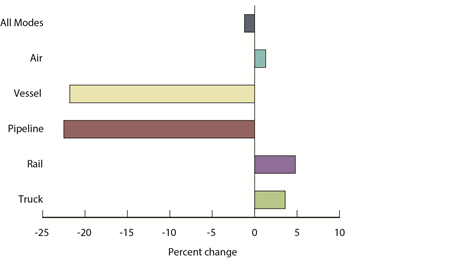
Percent change in value of U.S.-NAFTA freight flows by mode, January 2014 - January 2015.Graphic: U.S. DOT
2 min to read
Percent change in value of U.S.-NAFTA freight flows by mode, January 2014 - January 2015. Graphic: U.S. DOT
The amount of freight moved between the U.S. and its North American Free Trade Agreement neighbors of Canada and Mexico totaled $89.3 billion in January, according to U.S. Transportation Department figures, down 1.2% from a year earlier. Rail, truck, and air all carried more freight.
Ad Loading...
The value of freight flows between the U.S. and its neighbors by all modes decreased, as the value of cross-border trade by pipeline and vessel declined in January due to the reduced prices of mineral fuel shipments.
Ad Loading...
However, compared to a year earlier, the value of commodities moving by rail in January grew by 4.8%, the largest percentage of any mode. Truck freight increased by 3.6% and air rose by 1.3%. Vessel freight dropped 21.8% and pipeline freight fell 22.5%
Trucks carried 62.3% of U.S.-NAFTA freight and were the most heavily used mode for moving goods to and from both U.S.-NAFTA partners. Trucks accounted for $27.4 billion of the $47.5 billion of imports, or 57.7%, and $28.2 billion of the $41.8 billion of exports or 67.6%
Rail remained the second largest mode, moving 14.5% of all U.S.-NAFTA freight.
U.S.-Canada Freight
U.S.-Canada freight totaled $48.1 billion in January as three out of five transportation modes (air, truck, and rail) carried more U.S.-Canada freight than in January 2014. Year-over-year, the value of U.S.-Canada trade by air increased the most of any mode, growing by 3.4%. Truck freight increased by 2.7% and rail rose by 1.8%. Vessel freight decreased 19% and pipeline fell 22.5%
Ad Loading...
Trucks carried 55% of the $48.1 billion of freight to and from Canada, followed by rail at 15.7%, pipeline at 11.6%, vessel at 5.8% and air at 4.8%.
In January 2015, the top commodity category transported between the U.S. and Canada was mineral fuels, of which $5.6 billion, or 56.5%, moved by pipeline.
U.S.-Mexico Freight
U.S.-Mexico freight totaled $41.2 billion in January as two out of five transportation modes, rail and truck, carried more U.S.-Mexico freight than in January 2014. Year-over-year, the value of U.S.-Mexico rail freight rose 9.4%, the largest percentage increase of any mode. Freight carried by truck increased by 4.4%. Air freight decreased by 2.6%. Pipeline freight dropped 23.1% and vessel freight fell 23.5%.
Trucks carried 70.8% of the $41.2 billion of freight to and from Mexico, followed by rail at 13.1%.
Ad Loading...
The top commodity category transported between the U.S. and Mexico in January 2015 was electrical machinery, of which $7 billion, or 92.2%, moved by trucks.
ACT Research data shows volumes hitting a four-year high and supply-demand balance strengthening, but higher oil prices are undercutting tariff relief and tempering optimism.
The patent-pending cargo solution integrates a digitally connected cargo door and an intelligent locking system with the TrailerHawk.AI technology platform.
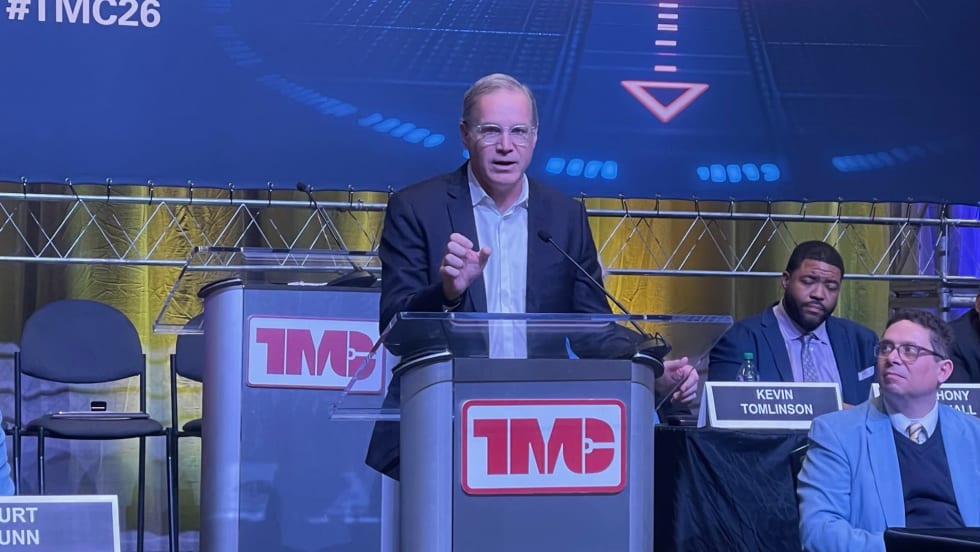
Speaking at the TMC Annual Meeting in Nashville, ATA President Chris Spear said trucking faces mounting pressure from rising fuel prices, geopolitical instability, and uncertainty around trade policy.
More than 100,000 new trucking companies enter the industry each year, but regulators manage to audit only a fraction of them. That churn creates opportunities for inexperienced startups — and for “chameleon carriers” that shut down after safety violations and reappear under new identities. Read more from Deborah Lockridge in this commentary.
HDTX is an intimate event that connects heavy-duty trucking fleet managers with industry suppliers through small-group discussions, educational sessions, and structured one-on-one meetings.
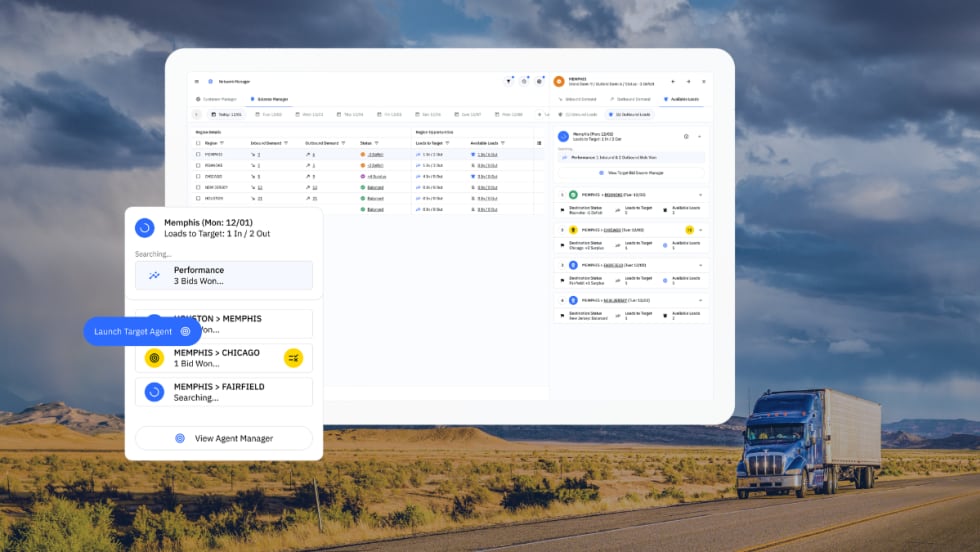
Optimal Dynamics says its new Scale platform uses AI agents and optimization to help carriers find and secure freight that improves network balance and profitability.
NACFE's Run on Less - Messy Middle project demonstrates the power of data in helping to guide the future of alternative fuels and powertrains for heavy-duty trucks.