



Spot market truck freight rates remain relatively strong but are down over the past week, according to new figures released by the freight matching service provider DAT Solutions.
 MENU
MENU SEARCH
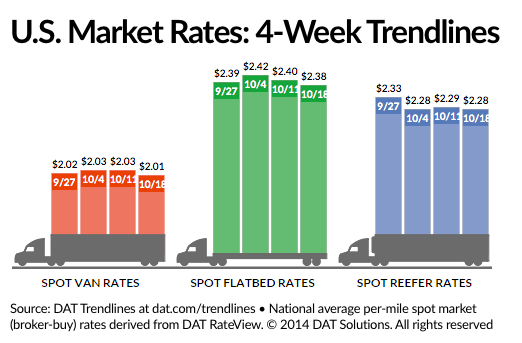
Vans reported the biggest decline from Oct. 12 through Oct. 18 compared to the previous seven days, falling 1% to an average of $2.01 per mile, though the rate has been above the $2 per mile level for most of the year.

Spot market truck freight rates remain relatively strong but are down over the past week, according to new figures released by the freight matching service provider DAT Solutions.
Vans reported the biggest decline from Oct. 12 through Oct. 18 compared to the previous seven days, falling 1% to an average of $2.01 per mile, though the rate has been above the $2 per mile level for most of the year.
Regionally, the average van rate is atypically high out of Los Angeles at $2.25 per mile, with rates from L.A. to Phoenix near the all-time peak average of $2.57 per mile on the strength of freight moving inland through the ports of Los Angeles and Long Beach, according to DAT. Average outbound van rates from Columbus, Ohio at $2.31 per mile, Dallas at $1.75 per mile, and Buffalo at $2.40 per mile remained solid as well. The average rate from Memphis was $2.32 per mile, down 6 cents, while Atlanta was unchanged at $2.02 per mile.
The average flatbed rate declined 0.8% to $2.38 per mile and is 4 cents less than it was two weeks ago, while the average reefer rate fell 0.4% to $2.28 per mile, a 5 cents drop over the past three weeks.
This happened as the number of spot market loads available to haul fell 5.6% while overall spot market truck capacity expanded by 5.6%.
Naturally, this led to declines in load-to-truck ratios falling, with the biggest happening in the flatbed sector, down 15% to 21.9 loads per truck.
The reefer load-to truck ratio dropped 11% to 7.8 loads per truck but remains “unusually strong in key seasonal markets,” according to DAT.
The van load-to-truck ratio declined the least of the three, 7.1%, to 2.8 loads per truck, which DAT said is relatively strong for this time of the year.
Despite the decline in rates they are expected to rise during the final quarter of the year, according to DAT Analyst Mark Montague in the company’s Freight Talk Blog.
He points to recent forecasts calling for holiday spending to increase at least 4% this year over last year while slightly more than half of shippers expect to pay peak surcharges to move their truckload freight during the period, though overall fourth quarter freight volume is not expected to increase dramatically.
.

The American Transportation Research Institute will examine driver coaching, regulatory impacts — including the "Beyond Compliance" concept —and weather disruptions that shape trucking operations.
Read More →
Fleet Advantage's Brian Antonellis says it's time for fleets to get back to the fundamentals of good maintenance practices. And that includes replacing older, inefficient equipment.
Read More →
Load matching for flatbed, lowbed, oversize and overweight loads can't be automated like basic van freight, but Truckstop.com is adding more high-tech tools to help.
Read More →
An expanded Trucker Path and Truckstop.com integration brings more freight opportunities into the TruckLoads app while emphasizing security and network quality.
Read More →
Strong March freight demand combined with a spike in fuel costs pushed both spot and contract truckload rates to their highest levels in more than two years.
Read More →
Everyone’s talking about AI — but is your transportation management system actually built for it?
Read More →
Being part of KTG will allow Sharp to expand and improve its services.
Read More →
The Fair Compensation for Truck Crash Victims Act would increase insurance requirements for interstate motor carriers by nearly seven times.
Read More →
Strong freight rates push TCI to 10.2, but FTR expects fuel-price volatility to skew March results.
Read More →
C.H. Robinson is waiving fees on fuel cards and cash advances for April and May, aiming to help carriers offset rising diesel costs tied to geopolitical instability.
Read More →