




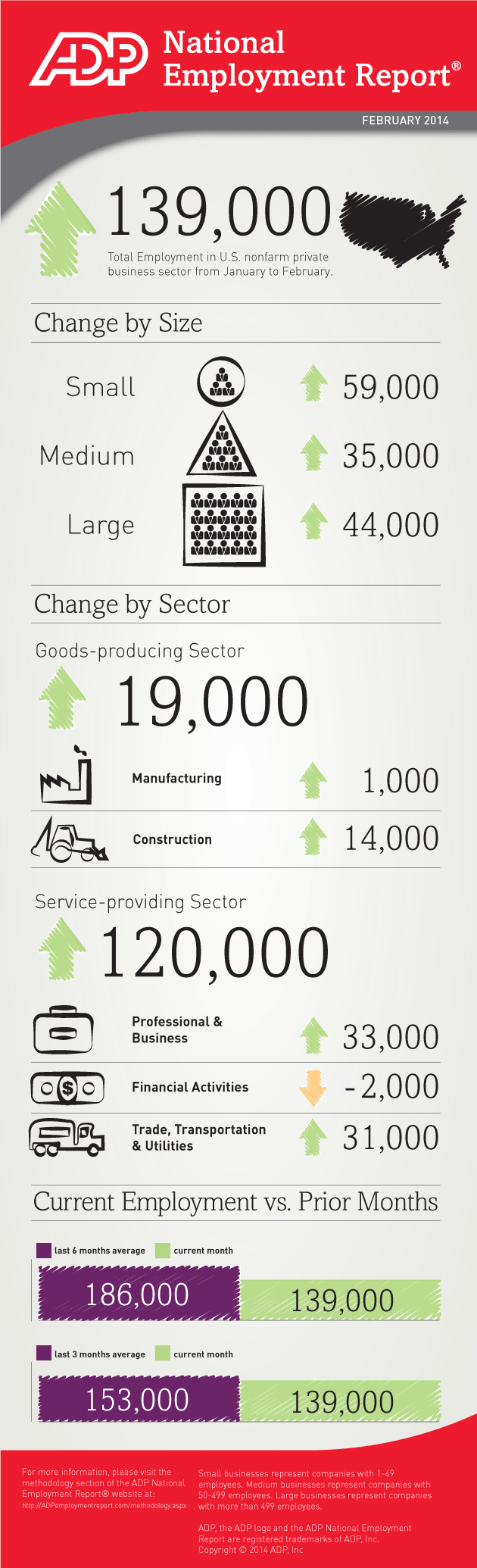
UPDATED -- Private sector employment increased by 139,000 jobs from January to February, according to the National Employment Report released Wednesday by the payroll management services provider ADP.
Economic Watch: Job Creation, Non-Manufacturing Employment Lose Steam
UPDATED -- Private sector employment increased by 139,000 jobs from January to February, according to the National Employment Report released Wednesday by the payroll management services provider ADP.

Evan Lockridge・Former Business Contributing Editor
3 min to read
The increase is well below the average over the last 12 months.
Mark Zandi, chief economist of Moody’s Analytics, said, "February was another soft month for the job market. Employment was weak across a number of industries. Bad winter weather, especially in mid-month, weighed on payrolls. Job growth is expected to improve with warmer temperatures.”

Payroll growth for businesses with 49 or fewer employees accelerated in February, adding 59,000 jobs. Though the month was improved from January, growth remains slower than previous months. The smallest gain for small businesses in 2013 was 71,000.
Employment levels among medium-sized companies, those with 50-499 employees, rose by 35,000 and employment at large companies, those with 500 or more employees, increased by 44,000. While this represented acceleration in job growth for large firms, growth at mid-size firms was slower than it has been since April 2013.
A separate report shows economic activity in the non-manufacturing sector grew in February for the 49th consecutive month, but the level was the slowest in four-years, according to the nation's purchasing and supply executives.
The report from the Institute for Supply Management show its Non-Manufacturing Index registered 51.6% in February, 2.4 percentage points lower than January's reading of 54%. The Non-Manufacturing Business Activity Index decreased to 54.6%, which is 1.7 percentage points lower than the reading of 56.3% reported in January, but reflects growth for the 55th consecutive month.
The New Orders Index registered 51.3%, 0.4 percentage point higher than the reading of 50.9% registered in January. The Employment Index decreased 8.9 percentage points to 47.5% from the January reading of 56.4% and indicates contraction in employment for the first time after 25 consecutive months of growth.
“A disappointing decline in headline service activity in February, suggesting a weakened consumer state,” said Lindsey Piegza, chief economist with the investment firm Sterne Agee. “However, improvement in the key forward-looking indicators, new orders and backlog, suggests improving momentum and activity in the pipeline.”
She notes while consumers have been cutting back on goods consumption, service consumption is on the rebound, particularly in health care. “In other words, unlike many of the retail indicators, we expect steady support, at least in the near term, reflecting consumers appetite for services,” she said.
A third report shows overall economic activity in the U.S. continued to expand from January into February.
The Federal Reserve “beige book” says reports from most of its regions indicate improved levels of activity, but in most cases the increases were characterized as modest to moderate.
New York and Philadelphia experienced a slight decline in activity, which was mostly attributed to the unusually severe weather experienced in those regions. Growth slowed in Chicago, and Kansas City reported that conditions remained stable during the reporting period. The outlook among most Districts remained optimistic.
Retail sales growth weakened since the previous report for most districts, as severe winter weather limited activity. However, Richmond, St. Louis, and Minneapolis reported modest sales growth since the beginning of the year. Weather was also cited as a contributing factor to softer auto sales in many districts, with the exception of Cleveland, which saw strong gains.
Manufacturing sales and production in several districts were negatively impacted by severe winter weather; however, modest improvements were noted in Boston, Atlanta, Minneapolis, and Dallas.
Residential real estate markets continued to improve in several areas, albeit modestly. Boston and New York gave mixed reports on sales, and Philadelphia, Cleveland, Minneapolis, and Kansas City noted a decrease in sales. Many districts cited low inventories of housing and continued home price appreciation.
Update adds Federal Reserve report.
More Fleet Management

'Beyond Compliance,' Regulations, Driver Coaching on ATRI’s 2026 Research List
The American Transportation Research Institute will examine driver coaching, regulatory impacts — including the "Beyond Compliance" concept —and weather disruptions that shape trucking operations.
Read More →
Fleet Advantage's Brian Antonellis on the Growing Need to Replace Old Trucks
Fleet Advantage's Brian Antonellis says it's time for fleets to get back to the fundamentals of good maintenance practices. And that includes replacing older, inefficient equipment.
Read More →
Truckstop.com Adding to Open Deck, Heavy Haul Offerings
Load matching for flatbed, lowbed, oversize and overweight loads can't be automated like basic van freight, but Truckstop.com is adding more high-tech tools to help.
Read More →
Trucker Path, Truckstop.com Expand Load Access Partnership
An expanded Trucker Path and Truckstop.com integration brings more freight opportunities into the TruckLoads app while emphasizing security and network quality.
Read More →
Truckload Rates Hit Two-Year Highs as Diesel Costs Surge, DAT Says
Strong March freight demand combined with a spike in fuel costs pushed both spot and contract truckload rates to their highest levels in more than two years.
Read More →
The AI Conversation You Need to Have with Your TMS Provider
Everyone’s talking about AI — but is your transportation management system actually built for it?
Read More →
Kriska Buys Fellow Canadian Carrier Sharp Transportation Systems
Being part of KTG will allow Sharp to expand and improve its services.
Read More →
Bill in House Would Raise Minimum Insurance for Motor Carriers to $5 Million
The Fair Compensation for Truck Crash Victims Act would increase insurance requirements for interstate motor carriers by nearly seven times.
Read More →
FTR Trucking Conditions Index Hits Four-Year High in February
Strong freight rates push TCI to 10.2, but FTR expects fuel-price volatility to skew March results.
Read More →
C.H. Robinson Offers Carriers Relief as Diesel Prices Surge
C.H. Robinson is waiving fees on fuel cards and cash advances for April and May, aiming to help carriers offset rising diesel costs tied to geopolitical instability.
Read More →