



Total intermodal shipments in the U.S. and Canada rose 2% over last year’s first quarter volumes despite port congestion issues that impacted international container traffic, according to new figures from the Intermodal Association of North America.
 MENU
MENU SEARCH
Total intermodal shipments in the U.S. and Canada rose 2% over last year’s first quarter volumes despite port congestion issues that impacted international container traffic, according to new figures from the Intermodal Association of North America.
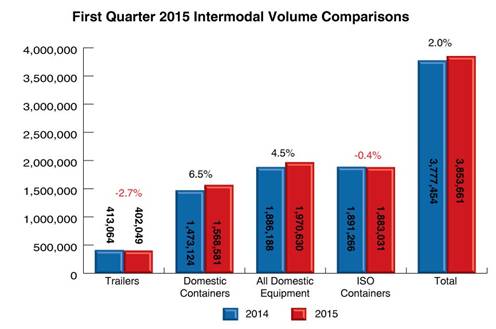
Graphic: IANA
Total intermodal shipments in the U.S. and Canada rose 2% over last year’s first quarter volumes despite port congestion issues that impacted international container traffic, according to new figures from the Intermodal Association of North America.
Domestic intermodal loads grew 4.5%, buoyed by domestic containers, which rose 6.5%.
“Monthly first quarter results were uneven due to the issues on the West Coast,” said Joni Casey, president and CEO of IANA. “Despite February’s challenges, however, we still saw some overall quarterly growth, led by big boxes in regions less affected by port congestion.”
According to IANA, domestic intermodal results were particularly impressive in view of the challenges facing the import sector. A significant share of the freight carried by domestic intermodal is trans-loaded from 40-foot containers that come through a port. First quarter volumes exceeded the 5.1% gain recorded in the fourth quarter of 2014.
Regional traffic growth remained tied to port issues, notwithstanding the relative strength of domestic intermodal. Volumes were down in the Southwest, which saw a 5.7% decline over the first quarter 2014. The Southeast surged 9.9% due to increases in both domestic and international containers. Western Canada posted the strongest growth rate of any region, jumping an exceptional 10.6% in the first quarter.
The seven largest volume corridors also varied according to their exposure to port disruptions. While lanes that included the Southwest were down, the intra-Southeast continued to be an intermodal powerhouse. Intermodal shipments in that lane jumped 16.5% from the fourth quarter of 2014. Overall, high-density lanes, which accounted for 64.5% of total volumes, saw a minimal decline of 0.9% in the most recent quarter
Intermodal marketing companies reported 3% growth in the first quarter, laying the groundwork for an even stronger performance in the coming months, according to IANA. Intermodal and highway loads jumped 3.2% and 2.6%, respectively. IMC highway gains were significant enough to push revenues up 1%, compared to first quarter of 2014.

ACT Research data shows volumes hitting a four-year high and supply-demand balance strengthening, but higher oil prices are undercutting tariff relief and tempering optimism.
Read More →
The patent-pending cargo solution integrates a digitally connected cargo door and an intelligent locking system with the TrailerHawk.AI technology platform.
Read More →
The impact of the Iran conflict extends beyond fuel costs, bringing more fraud and cybersecurity risks to the trucking industry.
Read More →
Speaking at the TMC Annual Meeting in Nashville, ATA President Chris Spear said trucking faces mounting pressure from rising fuel prices, geopolitical instability, and uncertainty around trade policy.
Read More →
More than 100,000 new trucking companies enter the industry each year, but regulators manage to audit only a fraction of them. That churn creates opportunities for inexperienced startups — and for “chameleon carriers” that shut down after safety violations and reappear under new identities. Read more from Deborah Lockridge in this commentary.
Read More →
HDTX is an intimate event that connects heavy-duty trucking fleet managers with industry suppliers through small-group discussions, educational sessions, and structured one-on-one meetings.
Read More →
New DAT One feature shows top-paying loads directly on an iPhone’s home screen, helping carriers react faster to spot-market opportunities.
Read More →
Optimal Dynamics says its new Scale platform uses AI agents and optimization to help carriers find and secure freight that improves network balance and profitability.
Read More →
DAT Freight & Analytics data shows tightening flatbed capacity, easing produce markets, and softening van and reefer rates.
Read More →
NACFE's Run on Less - Messy Middle project demonstrates the power of data in helping to guide the future of alternative fuels and powertrains for heavy-duty trucks.
Read More →