



In a strong second quarter showing, intermodal freight posted gains across all segments, according to new figures released by the Intermodal Association of North America.
 MENU
MENU SEARCH
International containers increased 9.6%, trailers improved by 4.3%, and domestic containers grew 7.6% quarter-over-quarter, all indications that the intermodal industry is recovering from a harsh winter and a contracted economy.
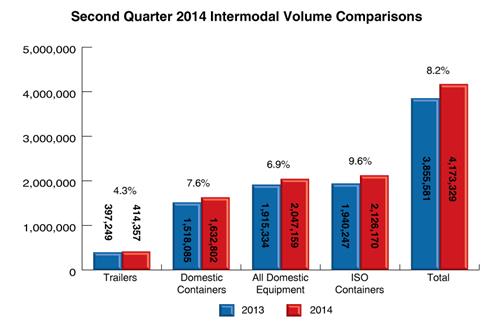
Credit: IANA
In a strong second quarter showing, intermodal freight posted gains across all segments, according to new figures released by the Intermodal Association of North America.
International containers increased 9.6%, trailers improved by 4.3%, and domestic containers grew 7.6% quarter-over-quarter, all indications that the intermodal industry is recovering from a harsh winter and a contracted economy.
Due in large part to second quarter strength, the first half of 2014 averaged 5.5% in total intermodal volume gains, just below the 5.8% growth recorded in the second half of 2013 and in-line with recent trends.
“The second quarter results were indicative of a rebounding economy and higher than predicted import shipments,” said Joni Casey, president and CEO of IANA. “It is also probable the harsh winter that resulted in constricted first quarter capacity contributed to the second quarter’s strong growth, by comparison.”
The seven highest-density trade corridors, accounting for two-thirds of total intermodal volume across the continent, rose 7.4% in the second quarter, falling below the 8.2% industry average.
Five of the seven bi-directional lanes recorded growth near or above industry averages. The Trans-Canada corridor, positively impacted by international intermodal shipments from Eastern Canada to Western Canada, led the way in corridor growth with a 10.5% quarter-over-quarter increase.
Eight of the nine IANA regions experienced growth in the second quarter, with six areas reporting increases larger than 10%. Of these six, all were heavily impacted by strong showings in international intermodal shipments. The Midwest and Southwest, the two largest IANA regions accounting for almost half of total loadings, climbed 6.3% and 7.8%, respectively.
Intermodal freight haulers posted second quarter growth rates that were more modest than the overall intermodal volume numbers, growing 2.4% from last year. Like much of the broader market, IMCs in part benefited from the robust showing from imports based on transloading opportunities, according to IANA.
Average revenue for both intermodal and highway IMC market segments continued its strong growth, with increases of 6% and 16.3% respectively. A month-by-month growth comparison indicates that April led the way with solid 4.2% gains, then slowed to 0.9% in May and 2% in June. In quarter-over-quarter comparisons, intermodal business accelerated 6.7%.

The American Transportation Research Institute will examine driver coaching, regulatory impacts — including the "Beyond Compliance" concept —and weather disruptions that shape trucking operations.
Read More →
Fleet Advantage's Brian Antonellis says it's time for fleets to get back to the fundamentals of good maintenance practices. And that includes replacing older, inefficient equipment.
Read More →
Load matching for flatbed, lowbed, oversize and overweight loads can't be automated like basic van freight, but Truckstop.com is adding more high-tech tools to help.
Read More →
An expanded Trucker Path and Truckstop.com integration brings more freight opportunities into the TruckLoads app while emphasizing security and network quality.
Read More →
Strong March freight demand combined with a spike in fuel costs pushed both spot and contract truckload rates to their highest levels in more than two years.
Read More →
Everyone’s talking about AI — but is your transportation management system actually built for it?
Read More →
Being part of KTG will allow Sharp to expand and improve its services.
Read More →
The Fair Compensation for Truck Crash Victims Act would increase insurance requirements for interstate motor carriers by nearly seven times.
Read More →
Strong freight rates push TCI to 10.2, but FTR expects fuel-price volatility to skew March results.
Read More →
C.H. Robinson is waiving fees on fuel cards and cash advances for April and May, aiming to help carriers offset rising diesel costs tied to geopolitical instability.
Read More →