Less Freight, More Trucks Push Spot Truckload Rates Lower
A decline in the amount of freight on the spot truckload market coupled with an increase in the number of trucks needing cargo pushed rates down across the board, according to new weekly figures from DAT Solutions that are based on its network of load boards.
Evan Lockridge・Former Business Contributing Editor
August 17, 2016
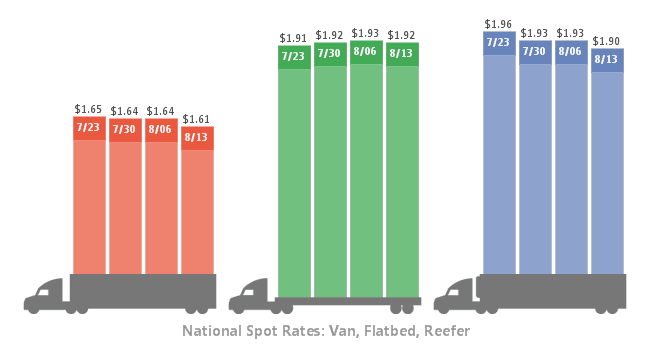
Average DAT spot market rates over the past four weeks.Graphic: DAT
2 min to read
Average DAT spot market rates over the past four weeks. Graphic: DAT
A decline in the amount of freight on the spot truckload market coupled with an increase in the number of trucks needing cargo,pushed rates down across the board, according to new weekly figures from DAT Solutions that are based on its network of load boards.
Ad Loading...
Overall freight availability fell 6.2% while truck postings increased 3.1% for the week ending August 13 compared to the previous week as the average diesel fuel price declined 0.4% to $2.31 per gallon.
Ad Loading...
The average dry van rate gave up 3 cents, hitting $1.61 per mile, which included a 1-cent drop in the average fuel surcharge. While outbound rates increased in Seattle and Allentown, they fell in Chicago and Atlanta. The average dry van rate is now lower than the June average for the first time in six weeks, a transition that typically occurs in the first week of July, according to DAT.
Likewise, the average reefer rate lost 3 cents, registering $1.90 per mile and is down 6 cents from three weeks earlier. Reefer prices rose in major markets in the Midwest, but were lower in the Northeast.
Flatbeds posted the smallest drop, just 1-cent and entirely due to a decline in the fuel surcharge, pushing the average rate to where it was two weeks earlier at $1.92 per mile.
Not surprisingly, with less freight and a hike in the number of truck postings, load-to-truck ratios fell in all three freight categories. The biggest was in the flatbed sector, falling 14% to 11 loads per truck. Flatbed load posts declined 11% last week while truck posts increased 4%.
The 7% drop in the van load-to-truck ratio happened as van load posts declined 4% last week and truck posts increased 3% yielding 2.5 loads per truck. Reefers were not far behind with a 5.5% drop. Reefer load posts edged down 3% last week while truck posts added 3%. That resulted in the load-to-truck ratio moving to 5 to 1.
ACT Research data shows volumes hitting a four-year high and supply-demand balance strengthening, but higher oil prices are undercutting tariff relief and tempering optimism.
The patent-pending cargo solution integrates a digitally connected cargo door and an intelligent locking system with the TrailerHawk.AI technology platform.
Speaking at the TMC Annual Meeting in Nashville, ATA President Chris Spear said trucking faces mounting pressure from rising fuel prices, geopolitical instability, and uncertainty around trade policy.
More than 100,000 new trucking companies enter the industry each year, but regulators manage to audit only a fraction of them. That churn creates opportunities for inexperienced startups — and for “chameleon carriers” that shut down after safety violations and reappear under new identities. Read more from Deborah Lockridge in this commentary.
HDTX is an intimate event that connects heavy-duty trucking fleet managers with industry suppliers through small-group discussions, educational sessions, and structured one-on-one meetings.
Optimal Dynamics says its new Scale platform uses AI agents and optimization to help carriers find and secure freight that improves network balance and profitability.
NACFE's Run on Less - Messy Middle project demonstrates the power of data in helping to guide the future of alternative fuels and powertrains for heavy-duty trucks.