




The latest gauge on the manufacturing sector showed that production contracted 0.5 percent in April, the first month-to-month decline since June 2009. However, total industrial production, which includes mining and utilities in addition to manufacturing, was unchanged during the month.
Manufacturing and Housing Slide in April, Total Production Unchanged
The latest gauge on the manufacturing sector showed that production contracted 0.5 percent in April, the first month-to-month decline since June 2009. However, total industrial production, which includes mining and utilities in addition to manufacturing, was unchanged during the month
by Staff
May 23, 2011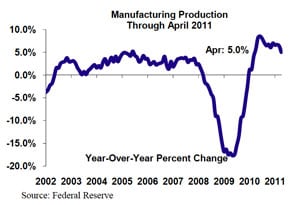
3 min to read
Eric Green, chief market economist at TD Securities Inc. in New York, told Bloomberg that "Job demand is real, and we're going to emerge past this soft patch." Another report that came out Friday showed fewer Americans than forecast filed first-time claims for unemployment benefits last week.
ATA's Economic Group notes that most of April's weakness in the manufacturing sector was due to an 8.9 percent plunge in auto production. The large drop in auto production was attributable to a shortage of parts from Japan in the wake of the earthquake there. Total durable goods production, which includes products with a useable life of at least three years, was down 1 percent in April, while nondurable goods output was up 0.1 percent.
In the bigger picture, compared with April 2010, total manufacturing was up 5 percent. Nearly all sectors saw year-over-year increases with only paper production (-1 percent) and petroleum and coal products (-2.7 percent) down from a year ago. Conversely, machinery output jumped more than 13 percent from April 2010.
Some economists point to "normalization," now that manufacturers have rebuilt much of the inventories they let draw down significantly during the recession, as another reason for the softening in manufacturing.
The Bureau of Transportation Statistics suggested that disruptions related to the disaster in Japan may last for quite some time. Damaged equipment, loss of power and disrupted intermodal infrastructure in Japan reduced shipping capacity and interfered with international trade links.
On March 21, General Motors announced that a shortage of electronic parts arriving from Japan forced the temporary closing of pickup truck manufacturing and assembly plants in New York and Louisiana. Other North America based automobile manufacturers, including Toyota, Nissan, and Honda, also suffered supply disruptions and shortages of essential automotive parts, such as electronics and paint pigments, from Japan.
On the other hand, earlier this month, GM announced it will invest $2 billion in plants in eight U.S. states as it works to boost production and market share. Bloomberg reports that GM's investment during the next year will support more than 28,000 U.S. jobs when including indirect employment at suppliers and work created from those employees spending their earnings, according to the Center for Automotive Research.
The earthquake also will affect worldwide demand for oil. The loss of Fukushima Dai-ichi nuclear plants, Japanese oil consumption is expected to increase by 238,000 million barrels per day as a substitution for power.
U.S. fuel demand climbed in April as the economy continued to grow. According to the American Petroleum Instritute, total deliveries of petroleum products, a measure of demand, climbed 5.2 percent to 19.9 million barrels a day last month from a year earlier. Diesel consumption alone climbed 26 percent to average 3.42 million barrels a day.
Housing was also down significantly in April. The Census Bureau reported that new housing starts plunged 10.6 percent in April to 523,000 units. While the housing market remains in the doldrums, the April data was particularly weak due to bad spring weather that delayed some starts. Single-family housing starts decreased 5.1 percent in April to the lowest level since February 2011. Compared with April 2010, starts were off nearly 24 percent. Single-family starts contracted 30.4 percent during the same period.
More broadly, the index of leading economic indicators, which is designed to forecast U.S. economic activity three to six months in the future, fell for the first time since June 2010. Specifically, the LEI decreased 0.3 percent in April. From June of last year through March of this year, the LEI had increased over 5 percent. Compared with April 2010, the LEI was up 4.1 percent.
More Fleet Management

'Beyond Compliance,' Regulations, Driver Coaching on ATRI’s 2026 Research List
The American Transportation Research Institute will examine driver coaching, regulatory impacts — including the "Beyond Compliance" concept —and weather disruptions that shape trucking operations.
Read More →
Fleet Advantage's Brian Antonellis on the Growing Need to Replace Old Trucks
Fleet Advantage's Brian Antonellis says it's time for fleets to get back to the fundamentals of good maintenance practices. And that includes replacing older, inefficient equipment.
Read More →
Truckstop.com Adding to Open Deck, Heavy Haul Offerings
Load matching for flatbed, lowbed, oversize and overweight loads can't be automated like basic van freight, but Truckstop.com is adding more high-tech tools to help.
Read More →
Trucker Path, Truckstop.com Expand Load Access Partnership
An expanded Trucker Path and Truckstop.com integration brings more freight opportunities into the TruckLoads app while emphasizing security and network quality.
Read More →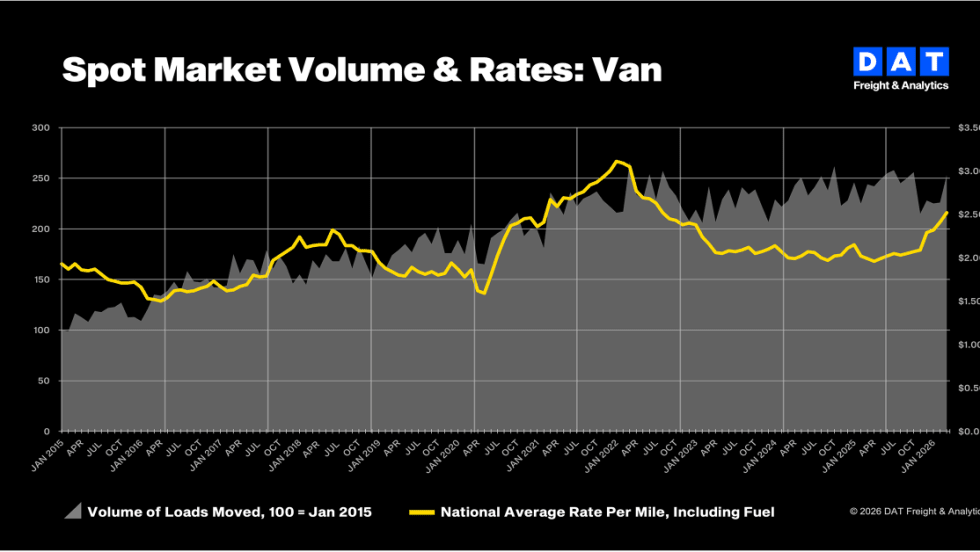
Truckload Rates Hit Two-Year Highs as Diesel Costs Surge, DAT Says
Strong March freight demand combined with a spike in fuel costs pushed both spot and contract truckload rates to their highest levels in more than two years.
Read More →
The AI Conversation You Need to Have with Your TMS Provider
Everyone’s talking about AI — but is your transportation management system actually built for it?
Read More →
Kriska Buys Fellow Canadian Carrier Sharp Transportation Systems
Being part of KTG will allow Sharp to expand and improve its services.
Read More →
Bill in House Would Raise Minimum Insurance for Motor Carriers to $5 Million
The Fair Compensation for Truck Crash Victims Act would increase insurance requirements for interstate motor carriers by nearly seven times.
Read More →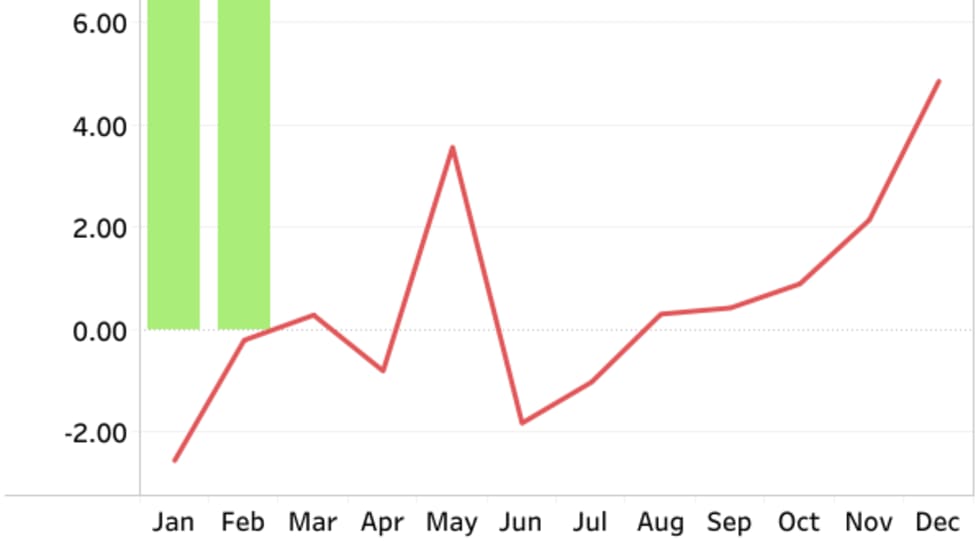
FTR Trucking Conditions Index Hits Four-Year High in February
Strong freight rates push TCI to 10.2, but FTR expects fuel-price volatility to skew March results.
Read More →
C.H. Robinson Offers Carriers Relief as Diesel Prices Surge
C.H. Robinson is waiving fees on fuel cards and cash advances for April and May, aiming to help carriers offset rising diesel costs tied to geopolitical instability.
Read More →