




Import cargo volume at the nation's major retail container ports will remain below last year's levels for the remainder of the summer before seeing year-over-year gains again this fall as retailers begin to stock up for the holiday season.
Retail Container Traffic Drops Below Last Year, Expected to See Gains as Holidays Approach

Import cargo volume at the nation's major retail container ports will remain below last year's levels for the remainder of the summer before seeing year-over-year gains again this fall as retailers begin to stock up for the holiday season
by Staff
August 9, 2011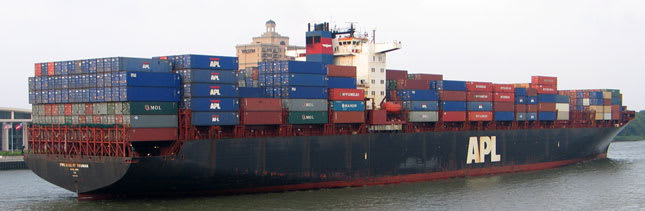
Year-over-year increases in retail container shipping are expected to resume in September. (Photo by Evan Lockridge)
3 min to read
The prediction comes from the Global Port Tracker report released by the National Retail Federation and Hackett Associates.
"Cargo numbers have been down this summer, but that's a reflection of last year's unusual shipping patterns more than the economy," NRF Vice President for Supply Chain and Customs Policy Jonathan Gold said. "The economy continues to face challenges, but job growth has been steady and retailers have been adding jobs themselves as sales improve."
Cargo figures for this fall clearly show that retailers are expecting a healthy holiday season, Gold said.
U.S. ports followed by Global Port Tracker handled 1.25 million Twenty-foot Equivalent Units in June, the latest month for which numbers are available. That was down 2.6% from May and 5% from June 2010. One TEU is one 20-foot cargo container or its equivalent.
June's volume broke an 18-month streak of year-over-year improvement dating to December 2009, and declines continued in July, which was estimated at 1.3 million TEU, down 5.7% from July 2010. August is forecast at 1.4 million TEU, a 1.6% decrease from a year ago.
Rather than indicating an economic downturn, however, the numbers are a skewed comparison against higher-than-normal numbers last summer, when fears of shortages in shipping capacity caused many retailers to bring holiday merchandise into the country earlier than usual. Actual retail sales have seen 12 straight months of growth.
Year-over-year increases are expected to resume in September, which is forecast at 1.48 million TEU, up 10.4% from last year.
The first half of 2011 totaled 7.15 million TEU, up 3.9% from the first half of 2010, and the full year is forecast at 15.28 million TEU, up 3.6% from 2010. Imports during 2010 totaled 14.7 million TEU, a 16% increase over unusually low numbers in 2009.
While cargo volume is expected to increase through this fall's holiday shipping cycle, Hackett Associates founder Ben Hackett said a number of key economic indicators are raising concerns about future cargo growth.
"Industrial production in China is weak, bulk commodity imports are declining, and ports are beginning to report reduced export volumes," Hackett said. "In the U.S., we have lower private consumption, lower government expenditure and lower indices like the purchasing managers' index. This is cause for concern because it could lead to lower growth of trade volumes."
IANA's 2Q numbers
Meanwhile, the Intermodal Association of North America reported that domestic and international intermodal volumes posted solid gains in the second quarter.
IANA's Intermodal Market Trends & Statistics report notes that domestic container volume grew 9% year-over-year, a stronger pace than during the previous two individual quarters. This rate of increase is especially impressive considering that the highest gain recorded, 16.4%, was posted in Q2 2010.
Although domestic containers recorded significant increases, trailer volumes had more modest gains, rising 4.6% over 2010 levels, a slightly slower pace than in the previous quarters that likely represents a continued equipment shift toward domestic containers. Domestic intermodal's strong pace was bolstered by a steep rise in diesel prices that likely made it more cost-effective for shippers to shift freight off the highway.
International intermodal volumes during the quarter increased 5.4% year-over-year. While this is the slowest rate of international growth since late 2009, it should be noted that previous quarters benefited from weak comparisons, says IANA. International shipments also would likely have been higher were it not for the disasters in Japan that reduced the volume of Japanese imports.
While the rate of intermodal growth slowed from the first quarter to the second quarter, IANA says it still remains in-line with many industry analyst estimates of 6-8% year-over-year expansion.
More Fleet Management

'Beyond Compliance,' Regulations, Driver Coaching on ATRI’s 2026 Research List
The American Transportation Research Institute will examine driver coaching, regulatory impacts — including the "Beyond Compliance" concept —and weather disruptions that shape trucking operations.
Read More →
Fleet Advantage's Brian Antonellis on the Growing Need to Replace Old Trucks
Fleet Advantage's Brian Antonellis says it's time for fleets to get back to the fundamentals of good maintenance practices. And that includes replacing older, inefficient equipment.
Read More →
Truckstop.com Adding to Open Deck, Heavy Haul Offerings
Load matching for flatbed, lowbed, oversize and overweight loads can't be automated like basic van freight, but Truckstop.com is adding more high-tech tools to help.
Read More →
Trucker Path, Truckstop.com Expand Load Access Partnership
An expanded Trucker Path and Truckstop.com integration brings more freight opportunities into the TruckLoads app while emphasizing security and network quality.
Read More →
Truckload Rates Hit Two-Year Highs as Diesel Costs Surge, DAT Says
Strong March freight demand combined with a spike in fuel costs pushed both spot and contract truckload rates to their highest levels in more than two years.
Read More →
The AI Conversation You Need to Have with Your TMS Provider
Everyone’s talking about AI — but is your transportation management system actually built for it?
Read More →
Kriska Buys Fellow Canadian Carrier Sharp Transportation Systems
Being part of KTG will allow Sharp to expand and improve its services.
Read More →
Bill in House Would Raise Minimum Insurance for Motor Carriers to $5 Million
The Fair Compensation for Truck Crash Victims Act would increase insurance requirements for interstate motor carriers by nearly seven times.
Read More →
FTR Trucking Conditions Index Hits Four-Year High in February
Strong freight rates push TCI to 10.2, but FTR expects fuel-price volatility to skew March results.
Read More →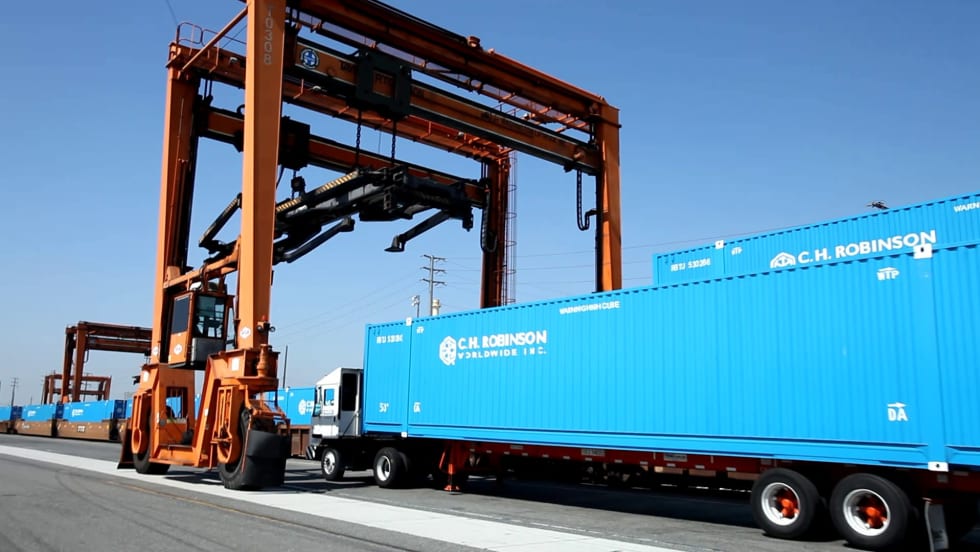
C.H. Robinson Offers Carriers Relief as Diesel Prices Surge
C.H. Robinson is waiving fees on fuel cards and cash advances for April and May, aiming to help carriers offset rising diesel costs tied to geopolitical instability.
Read More →