




One economist is predicting continued slow growth for the economy, but believes our current economic models aren’t working when it comes to federal fiscal policy.
 MENU
MENU SEARCH
One economist is predicting continued slow growth for the economy, but believes our current economic models aren’t working when it comes to federal fiscal policy.
One economist is predicting continued slow growth for the economy, but believes our current economic models aren’t working when it comes to federal fiscal policy.
During FTR’s monthly “State of Freight” webcast series, senior consultant and economic expert Bill Witte confessed that there are so many inconsistencies in the economic indicators that he’s “not real confident right now about my understanding about what’s going on in the U.S. economy.”
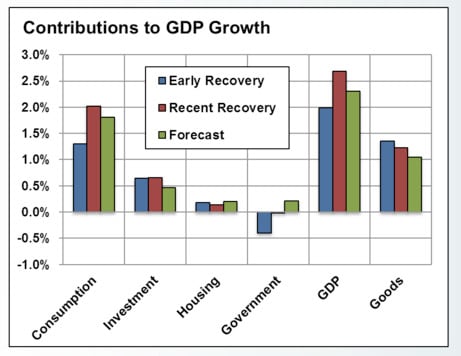
Early this year, after five months of over 3% economic growth, he felt we were finally in a more robust stage of recovery after limping along at around 2% growth since the end of the Great Recession.
Then came the severe winter weather. Then came a downward revision of those rosy 2014 second-half numbers. Add that and the additional three most recent months of figures, he said, and you see an average of 2.2% growth over the entire period of the recovery.
This, he said, is a continued trend of what some economists call “the new normal,” reflecting a different pattern from previous economic recoveries that were characterized by rapid growth.
And he forecasts that trend of slow but steady growth to continue. For the fourth quarter of 2015 he believes we’ll see about 2% growth, and expects 2016 to be a little better, averaging 2.4%.
The areas driving economic growth have shifted, he said. In the early part of the recovery it was more goods-based, but it is moving to more service-based.
The labor market, he said, will start to reach the point of what is considered “full employment,” which is around 5%, depending on which economist you talk to. WItte’s model pegs it at 4.8%, and predicts by the end of this year it will drop to 5% and by the end of 2016 to 4.9%. “So the decline in unemployment we’ve seen over the last five years pretty much ends; you’re getting to the point where you can’t drive unemployment a lot lower than it is now.”
He does not see any indications that a recession is looming. The average length of a recovery, going back to WWII, is about five years. We’re now at six years snd counting, he said, but “I don’t think right now there’s anything that indicates the likelihood of a recession.
"I think we will have something that produces a recession sometime in the next three years. But the timing of it is impossible to predict, and the nature of the recession also is impossible to predict. I don’t see a lot of imbalances in the economy right now except for the financial sector, and recessions usually occur when there’s some type of imbalance we need to correct.”
However, there are always what economists call “downside risks,” things that could happen to bring economic activity worse than forecast. With cited the international situation, particularly what happens as China’s economy slows; regulatory over-reach; and the Fed’s monetary policy.
Witte believes there are shortcomings in our current understanding of macro economics as it relates to the Federal Reserve’s monetary policy.
“We have a lot of experience now with central banks holding rates at very low levels,” he said, including Japan, which has been doing this for some time. In both Japan and the U.S., he said, economic growth has been subpar.
“Current economic theory ays low interest rates should stimulate the economy, and it’s just not working. There’s something about our [economic] models that the real world is telling us is wrong. I don’t know what the correct model is, but the current ones are inadequate.”
As a result, he said, the financial sector has become imbalanced, distorted. Imbalances, he said, will eventually correct. “That means when the Fed does change policies, the results are highly unpredictable.”

The American Transportation Research Institute will examine driver coaching, regulatory impacts — including the "Beyond Compliance" concept —and weather disruptions that shape trucking operations.
Read More →
Fleet Advantage's Brian Antonellis says it's time for fleets to get back to the fundamentals of good maintenance practices. And that includes replacing older, inefficient equipment.
Read More →
Load matching for flatbed, lowbed, oversize and overweight loads can't be automated like basic van freight, but Truckstop.com is adding more high-tech tools to help.
Read More →
An expanded Trucker Path and Truckstop.com integration brings more freight opportunities into the TruckLoads app while emphasizing security and network quality.
Read More →
Strong March freight demand combined with a spike in fuel costs pushed both spot and contract truckload rates to their highest levels in more than two years.
Read More →
Everyone’s talking about AI — but is your transportation management system actually built for it?
Read More →
Being part of KTG will allow Sharp to expand and improve its services.
Read More →
The Fair Compensation for Truck Crash Victims Act would increase insurance requirements for interstate motor carriers by nearly seven times.
Read More →
Strong freight rates push TCI to 10.2, but FTR expects fuel-price volatility to skew March results.
Read More →
C.H. Robinson is waiving fees on fuel cards and cash advances for April and May, aiming to help carriers offset rising diesel costs tied to geopolitical instability.
Read More →