Spot Freight Rates Hold as Load Volume Gains Slightly
The final week of any month usually means a bump in freight activity as shippers move goods prior to closing their books. However, the number of loads posted on the DAT network of load boards edged up just 2% for the the week ending April 29, according to DAT Solutions.
Evan Lockridge・Former Business Contributing Editor
May 3, 2017
Graphic: DAT
3 min to read
Graphic: DAT
The final week of any month usually means a bump in freight activity as shippers move goods prior to closing their books. However, the number of loads posted on the DAT network of load boards edged up just 2% for the the week ending April 29, according to DAT Solutions.
Ad Loading...
With truck posts rising 8%, load-to-truck ratios fell with the biggest declines seen by reefers, down 13% to 5.8 loads per truck. Flatbeds fell 7% but still at a very healthy 44.5 to 1 level, while vans slipped 4% to 3.4 loads per truck.
Ad Loading...
While April may have ended quietly, rates rose for all trailer types during the month and load-to-truck ratios were above seasonal norms, signaling a strong start to the second quarter, according to DAT.
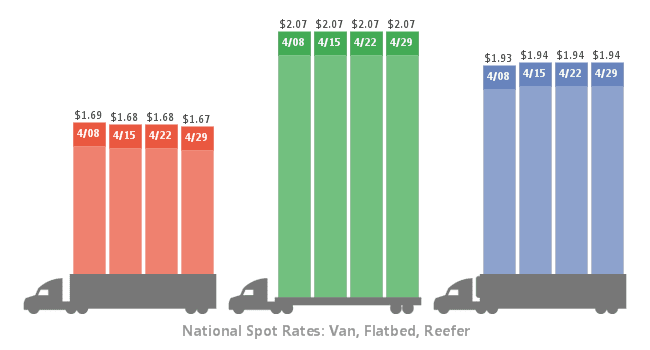
The national average van rate dipped 1 cent to $1.67 per mile, but that rate is still 4 cents higher than the March average while the national reefer rate remained at $1.94 per mile for the third straight week, but that’s 7 cents better than the March average. The average flatbed rate was unchanged at $2.07 per mile throughout April, but 4 cents better than the March average
Reefer load posts declined 5% while truck posts increased 10%. But compared to the same period in 2015 and 2016, reefer load-to-truck ratios are solid.
If you looked at the national average reefer rate, you might think that there wasn’t much happening in the spot market. But there was an influx of produce crossing the Mexican border last week, said DAT, and reefer load-to-truck ratios surged in Nogales, Laredo, and especially McAllen, where volumes soared 64%.
After wildfires interrupted traffic in Florida, produce started moving out of the state again last week. Key outbound lanes there are:
Ad Loading...
Miami-Northern New Jersey reefer rates were up 17 cents to $2.26 per mile
Lakeland-Baltimore added 24 cents to $2.24 per mile
A higher load count out of the Fresno area was offset by declines farther south in California. In fact, California was behind Texas, Florida, and Georgia for reefer load availability.
DAT said it has been hearing a lot about shipping gaps in California due to delays in planting because of an unusually wet winter, which explains the flat volumes last week. The upside, it believes, is that the best is yet to come, as the multi-year drought is mostly finished, and California produce should be gaining strength in the coming weeks.
Meantime, in the van sector, load posts increased 4% while truck posts increased 8%. On the top 100 van lanes, 50 were down in volume, 41 were up, and 9 were neutral. Most changes were slight, though:
Los Angeles outbound jumped 3 cents to $2.00 per mile
Seattle-Spokane hit $2.48 per mile, up 6 cents
Houston-New Orleans rose 8 cents to $2.28 per mile
Houston-Oklahoma City added 10 cents for $1.91 per mile, a springtime high
Ad Loading...
Outbound freight volume and rates declined in Philadelphia, $1.68 per mile, down 6 cents, giving up gains made earlier in the month. Philadelphia-Boston tumbled 22 cents to an average of $3.12 per mile.
Finally, in the flatbed market, after a 20% gain last week, the flatbed load-to-truck ratio settled down 2% to 44.5. Flatbed load posts increased 2% while truck posts were up 10%. Initial numbers show the flatbed load to truck ratio in April increased 19% when compared to March and is 102% better than it was in April of 2016.
ACT Research data shows volumes hitting a four-year high and supply-demand balance strengthening, but higher oil prices are undercutting tariff relief and tempering optimism.
The patent-pending cargo solution integrates a digitally connected cargo door and an intelligent locking system with the TrailerHawk.AI technology platform.
Speaking at the TMC Annual Meeting in Nashville, ATA President Chris Spear said trucking faces mounting pressure from rising fuel prices, geopolitical instability, and uncertainty around trade policy.
More than 100,000 new trucking companies enter the industry each year, but regulators manage to audit only a fraction of them. That churn creates opportunities for inexperienced startups — and for “chameleon carriers” that shut down after safety violations and reappear under new identities. Read more from Deborah Lockridge in this commentary.
HDTX is an intimate event that connects heavy-duty trucking fleet managers with industry suppliers through small-group discussions, educational sessions, and structured one-on-one meetings.
Optimal Dynamics says its new Scale platform uses AI agents and optimization to help carriers find and secure freight that improves network balance and profitability.
NACFE's Run on Less - Messy Middle project demonstrates the power of data in helping to guide the future of alternative fuels and powertrains for heavy-duty trucks.