




Freight rates are generally up on the spot market while the amount of available freight has declined a little.
Spot Freight Rates Increased as September Ended
Freight rates are generally up on the spot market while the amount of available freight has declined a little.

Evan Lockridge・Former Business Contributing Editor
Credit: DAT
4 min to read

The freight-matching service provider DAT reports from Sept. 29 through October 5 spot market load availability fell 0.5% from the previous seven days.
This came as load-to-truck ratios improved across the board with it being led by a 6.4% increase for vans, followed by a 3.2% hike for reefers and a 0.4% gain for flatbeds.
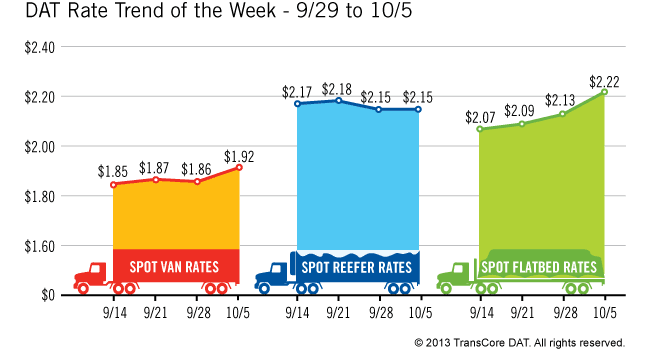
Rates for flatbeds saw the biggest increase, adding 4.2% during the comparable periods, for an average of $2.22 per mile, the best out of the last four weeks. DAT notes load volume dropped, so this may be a temporary, end-of-quarter spike.
Van rates also turned in its best performance out of the last month, increasing 3.2% to $1.92 per mile, but two key hubs in Chicago and L.A. were down, which could signal a slow down in the weeks to come.
In contrast, reefer rates were unchanged at $2.15 per mile, but when September is compared to August, reefer rates rose 2.9% to an average of $2.15 per mile in September.
Writing for the DAT Freight Talk Blog, DAT Analyst Mark Montague noted Monday marked the end of the month and the end of the third quarter, which coincided with the end of the U.S. government's fiscal year. “Some corporations also ended their fiscal year on Monday, and we saw a surge of freight on the spot market last week to close the books on a high note,” he wrote.
He said the word out of California is that a surge of freight is arriving at the Port of L.A. and Long Beach, and logistics companies in the Golden State are seeing a lot of action right now. “That bodes well for Christmas retail orders, despite a recent dip in consumer confidence,” he said.
Montague also pointed out that the recent government shutdown has left trucking without the weeklu USDA Fruit and Vegetable Truckload Rate Report, forcing him to rely on his resources at DAT to produce his own similar report.
You can take a look at it by logging on to the DAT website (
Freight rates are generally up on the spot market while the amount of available freight has declined a little.
The freight-matching service provider DAT reports from Sept. 29 through October 5 spot market load availability fell 0.5% from the previous seven days.
This came as load-to-truck ratios improved across the board with it being led by a 6.4% increase for vans, followed by a 3.2% hike for reefers and a 0.4% gain for flatbeds.
Rates for flatbeds saw the biggest increase, adding 4.2% during the comparable periods, for an average of $2.22 per mile, the best out of the last four weeks. DAT notes load volume dropped, so this may be a temporary, end-of-quarter spike.
Van rates also turned in its best performance out of the last month, increasing 3.2% to $1.92 per mile, but two key hubs in Chicago and L.A. were down, which could signal a slow down in the weeks to come.
In contrast, reefer rates were unchanged at $2.15 per mile, but when September is compared to August, reefer rates rose 2.9% to an average of $2.15 per mile in September.
Writing for the DAT Freight Talk Blog, DAT Analyst Mark Montague noted Monday marked the end of the month and the end of the third quarter, which coincided with the end of the U.S. government's fiscal year. “Some corporations also ended their fiscal year on Monday, and we saw a surge of freight on the spot market last week to close the books on a high note,” he wrote.
He said the word out of California is that a surge of freight is arriving at the Port of L.A. and Long Beach, and logistics companies in the Golden State are seeing a lot of action right now. “That bodes well for Christmas retail orders, despite a recent dip in consumer confidence,” he said.
Montague also pointed out that the recent government shutdown has left trucking without the weeklu USDA Fruit and Vegetable Truckload Rate Report, forcing him to rely on his resources at DAT to produce his own similar report.
You can take a look at it by logging on to the DAT website which Montague says he will publish until the USDA comes back on line with its weekly summary.
More Drivers

FMCSA Extends Paper Medical Card Exemption … Again
Five states still aren't ready to accept commercial driver medical exam information directly from the medical examiner's registry.
Read More →
Mack Launches Digital Driver Guide for Chassis-Specific Truck Info
Mack’s new, virtual owner’s manual delivers VIN-based, on-demand guidance for vehicle systems via web, app, and soon in-cab displays.
Read More →
Western Star Showcases Truckers' Pride and Skill
Western Star is expanding its Star Nation Experience in 2026, adding new competitions and dealer participation to highlight operator skills and promote careers in trucking.
Read More →
Best Fleets to Drive For: Two Carriers Earn Overall Award for First Time
CarriersEdge announced the 2026 Best Fleets to Drive For overall winners, with Crawford Trucking, Fortigo Freight Services, and FTC Transportation receiving top awards.
Read More →
Federal Proposal Would Allow Pell Grants for Shorter-Term Job Training
The Department of Labor plans to expand Pell Grant eligibility to some shorter workforce training programs, a move the American Trucking Associations said will help strengthen commercial driver training schools and diesel technician training programs.
Read More →
Owner-Operator Model Gets Boost as DOL Proposes 2024 Independent Contractor Definition Reversal
For an industry that has watched this issue go back and forth for years, the independent contractor proposal marks the latest swing in the regulatory pendulum.
Read More →
FMCSA Reinstates Field Warrior ELD to Registered Device List
One electronic logging device has been reinstated to the FMCSA's list of registered ELDs.
Read More →
How One Company is Using Smart Suspension Technology to Reduce Driver Injuries and Improve Retention
America’s Service Line adopted Link’s SmartValve and ROI Cabmate systems to address whole-body vibration, repetitive strain, and driver turnover. The trucking fleet is already seeing measurable results.
Read More →
CarriersEdge Announces 2026 Best Fleets to Drive For
The 18th annual contest recognizing the best workplaces for truck drivers sees changes to Top 20, Hall of Fame
Read More →
FMCSA Targets 550+ ‘Sham’ CDL Schools in Nationwide Sting Operation
The Federal Motor Carrier Safety Administration issued more than 550 notices of proposed removal to commercial driver training providers following a five-day nationwide enforcement sweep. Investigators cited unqualified instructors, improper training vehicles, and failure to meet federal and state requirements.
Read More →