



Despite a 2.5% decline in the number of loads available and nearly a 1.4% increase in truck capacity on one of the nation’s biggest spot freight markets, rates picked up recently.
 MENU
MENU SEARCH
Despite a 2.5% decline in the number of loads available and nearly a 1.4% increase in truck capacity on one of the nation’s biggest spot freight markets, rates have picked up.
Despite a 2.5% decline in the number of loads available and nearly a 1.4% increase in truck capacity on one of the nation’s biggest spot freight markets, rates picked up recently.
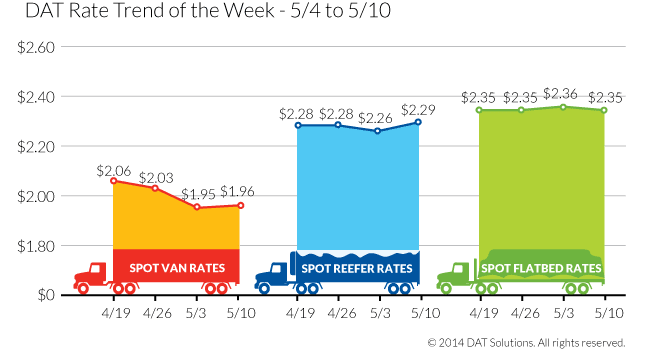
DAT reports reefers posted a 1.3% increase in its average rate May 4 through May 10, compared to the previous seven days, hitting $2.29 per mile, due to its seasonal climb and its load-to-truck ratio improving by 1.3%.
Van rates showed a 0.5% improvement, hitting $1.96 per mile, but that’s still 10 cents less that it was the week of April 19, while flatbeds lost just 0.4% at $2.35 per mile, close to where its been during the past month.
Load-to-truck ratios for vans fell 2.3% during this time while it moved 6.3% lower for flatbeds.
April Freight Volume Slips
Meantime, truckload freight levels on DAT’s spot market began a gradual decline toward seasonal norms in April, following extraordinary volume in the first quarter, according to its North American Freight Index
“Extreme weather, as well as economic and regulatory factors, reduced fleet productivity and disrupted supply chain operations throughout the winter, driving a larger proportion of shippers and intermediaries to the spot market for elusive truck capacity,” the company said.

Spot market freight volume continued to trend well above historic norms in April, up 51% compared to the same month in 2013. Freight designated for vans, the predominant equipment category, was up 48%, refrigerated freight increased 53% and flatbed freight saw a 66% increase.
Compared to the record-breaking levels of March, however, total freight volume slipped 8.8% in April. A decline from March to April has occurred twice in the last 5 years, according to DAT. Month-over-month, April van and reefer freight volume contracted 22% and 25%, respectively. Flatbed loads increased 10% month over month in an expected seasonal pattern.
Significant year-over-year rate increases accompanied the unusually high volume for all three major equipment types. Rates rose 19% for vans, 20% for reefers, and 12% for flatbeds, compared to April 2013. On a month-over-month basis, however, van rates declined 3.8% from March's record highs. Rates rose 2.3% for reefers and 4% for flatbeds, due to strong seasonal trends that affect cargo availability for those equipment types.

ACT Research data shows volumes hitting a four-year high and supply-demand balance strengthening, but higher oil prices are undercutting tariff relief and tempering optimism.
Read More →
The patent-pending cargo solution integrates a digitally connected cargo door and an intelligent locking system with the TrailerHawk.AI technology platform.
Read More →
The impact of the Iran conflict extends beyond fuel costs, bringing more fraud and cybersecurity risks to the trucking industry.
Read More →
Speaking at the TMC Annual Meeting in Nashville, ATA President Chris Spear said trucking faces mounting pressure from rising fuel prices, geopolitical instability, and uncertainty around trade policy.
Read More →
More than 100,000 new trucking companies enter the industry each year, but regulators manage to audit only a fraction of them. That churn creates opportunities for inexperienced startups — and for “chameleon carriers” that shut down after safety violations and reappear under new identities. Read more from Deborah Lockridge in this commentary.
Read More →
HDTX is an intimate event that connects heavy-duty trucking fleet managers with industry suppliers through small-group discussions, educational sessions, and structured one-on-one meetings.
Read More →
New DAT One feature shows top-paying loads directly on an iPhone’s home screen, helping carriers react faster to spot-market opportunities.
Read More →
Optimal Dynamics says its new Scale platform uses AI agents and optimization to help carriers find and secure freight that improves network balance and profitability.
Read More →
DAT Freight & Analytics data shows tightening flatbed capacity, easing produce markets, and softening van and reefer rates.
Read More →
NACFE's Run on Less - Messy Middle project demonstrates the power of data in helping to guide the future of alternative fuels and powertrains for heavy-duty trucks.
Read More →