





Former employees from Google, Apple and Tesla have jumped into the “self-driving trucks” waters, saying they’ll develop a retrofittable autonomous-driving technology for on-highway commercial heavy trucks.
Startup Says it's Developing Add-On Autonomous Truck Technology
Former employees from Google, Apple and Tesla have jumped into the “self-driving trucks” waters, saying they’ll develop a retrofittable autonomous-driving technology for on-highway commercial heavy trucks.
May 18, 2016
3 min to read
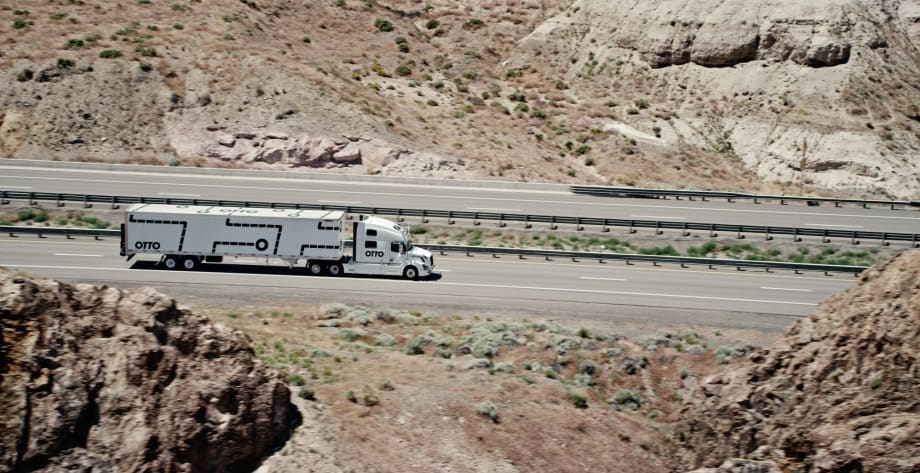
The company, called Otto, has outfitted three cabs with its automated technology and conducted its first extended test on public highways in Nevada last weekend.
Heading up the effort is Anthony Levandowski, who left his job working at Google on their self-driving car to found Otto with two other former Google employees, Lior Ron and Don Burnette, and another robotics expert, Claire Delaunay.
In a blog post, Levandowski and Ron write, “At the heart of our vision is the belief that self-driving tech is the key for creating a more sustainable, productive — and above all, safer — transportation future. … We are at Otto because we’re driven by an urgency and deep obligation to accelerate the future….
“We are developing a suite of sensors, software and truck enhancements coming together in a product that can be quickly outfitted on existing trucks.”
Otto is not the first to demonstrate autonomous truck technology. Daimler Trucks last fall in Germany ran a real-world test of what it says is the first series-production truck to operate on an automated basis on the highway. This followed on-highway demonstrations of concept vehicles, the Freightliner Inspiration truck in the U.S. in Nevada (the first autonomous truck legally licensed to travel on public highways in the country) and the Future Truck 2025 earlier in Germany.
However, even Daimler admits that there is a long road ahead to get to true “self driving trucks,” noting that It will take rewriting a sheaf of regulations and presenting a compelling business case on safety and fuel-economy gains to fleet operators before a Level 3 autonomous truck, like the Freightliner Inspiration demonstration truck, becomes a production tractor.
In an Associated Press story on the new Otto venture, Steven Shladover, program manager for mobility at the University of California's Partners for Advanced Transportation Technology, told AP Technology Writer Michael Liedtke that the technology has a long way to go before government regulators trust it to handle a rig at highway speeds without a driver in the seat.
"I don't want to be on that highway when there is nobody there to take over a truck with 80,000 pounds of cargo, and I don't think I know anyone else who would want to be," Shladover said. "The consequences of any kind of failure in any component would be too severe.”
According to AP, Otto is looking for 1,000 volunteers to have the system installed on their trucks to help fine-tune the technology. “The volunteer truckers would still be expected to seize the wheel and take control of the truck if the technology fails or the driving conditions make it unsafe to remain in autonomous mode, mirroring the laws governing tests of self-driving cars on public streets and highways.”
The New York Times reports that while California laws prohibit Otto’s vision of an autonomous truck operating with the driver snoozing in the sleeper, other state laws would allow it.
As the paper reports: “‘Right now, if you want to drive across Texas with nobody at the wheel, you’re 100 percent legal,’ said Mr. Levandowski, who as a Google engineer, helped write draft legislation that permitted self-driving vehicles, which later became law in Nevada.”
More Fleet Management

'Beyond Compliance,' Regulations, Driver Coaching on ATRI’s 2026 Research List
The American Transportation Research Institute will examine driver coaching, regulatory impacts — including the "Beyond Compliance" concept —and weather disruptions that shape trucking operations.
Read More →
Fleet Advantage's Brian Antonellis on the Growing Need to Replace Old Trucks
Fleet Advantage's Brian Antonellis says it's time for fleets to get back to the fundamentals of good maintenance practices. And that includes replacing older, inefficient equipment.
Read More →
Truckstop.com Adding to Open Deck, Heavy Haul Offerings
Load matching for flatbed, lowbed, oversize and overweight loads can't be automated like basic van freight, but Truckstop.com is adding more high-tech tools to help.
Read More →
Trucker Path, Truckstop.com Expand Load Access Partnership
An expanded Trucker Path and Truckstop.com integration brings more freight opportunities into the TruckLoads app while emphasizing security and network quality.
Read More →
Truckload Rates Hit Two-Year Highs as Diesel Costs Surge, DAT Says
Strong March freight demand combined with a spike in fuel costs pushed both spot and contract truckload rates to their highest levels in more than two years.
Read More →
The AI Conversation You Need to Have with Your TMS Provider
Everyone’s talking about AI — but is your transportation management system actually built for it?
Read More →
Kriska Buys Fellow Canadian Carrier Sharp Transportation Systems
Being part of KTG will allow Sharp to expand and improve its services.
Read More →
Bill in House Would Raise Minimum Insurance for Motor Carriers to $5 Million
The Fair Compensation for Truck Crash Victims Act would increase insurance requirements for interstate motor carriers by nearly seven times.
Read More →
FTR Trucking Conditions Index Hits Four-Year High in February
Strong freight rates push TCI to 10.2, but FTR expects fuel-price volatility to skew March results.
Read More →
C.H. Robinson Offers Carriers Relief as Diesel Prices Surge
C.H. Robinson is waiving fees on fuel cards and cash advances for April and May, aiming to help carriers offset rising diesel costs tied to geopolitical instability.
Read More →